THE DUTCH EMPIRE: HOW THE NETHERLANDS BUILT A GLOBAL EMPIRE
The Dutch Empire grew from a republican trading state, chartered companies and maritime warfare, linking Amsterdam to Asia, Africa and the Americas while relying on conquest, slavery and forced labor.
The Dutch Empire was built in stages. The Dutch Republic won independence from Spain, Amsterdam became a major financial and commercial center, and chartered companies projected Dutch power across the Indian Ocean, the Atlantic and Southeast Asia. The VOC and WIC were private corporations with public powers, while later colonial territories came under direct government. Trade, navigation, finance, science and art flourished alongside conquest, slavery, forced labor and colonial violence.
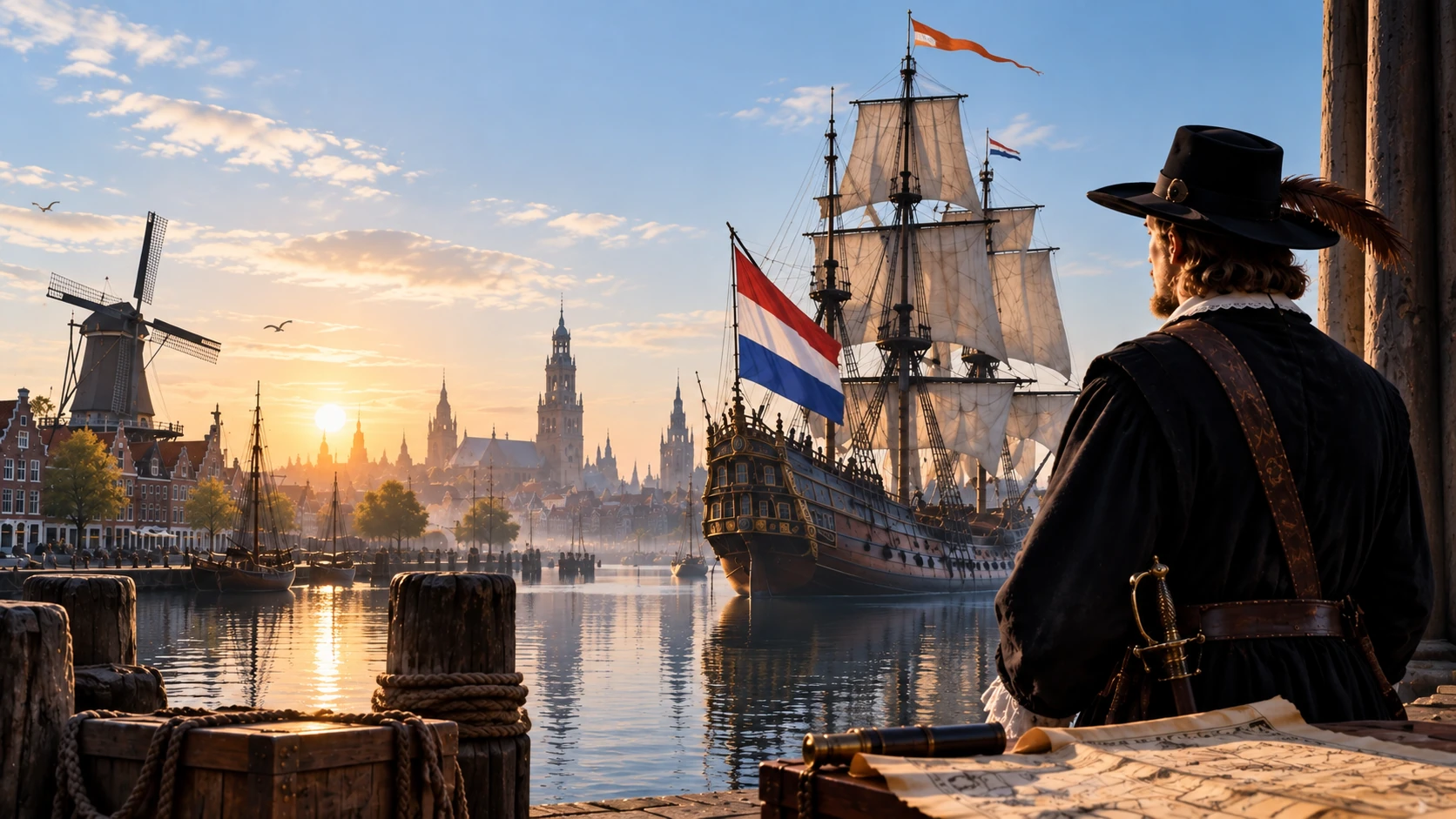
The supplied hero image is an editorial reconstruction of the Dutch maritime world. It is not a documentary view of a specific seventeenth-century harbor or voyage.
FROM DUTCH REVOLT TO REPUBLIC
The Low Countries were ruled by the Habsburg monarchy when resistance to Philip II of Spain grew in the late sixteenth century. Religious conflict, taxation, provincial privileges and opposition to royal centralization turned into the Dutch Revolt. The Union of Utrecht in 1579 joined several northern provinces, and the Act of Abjuration in 1581 declared that Philip had forfeited authority. War continued, and the Dutch Republic became a confederation of provinces rather than a centralized kingdom.
William of Orange became the revolt’s most important political symbol, but the republic was governed through the States General, provincial estates, town governments and powerful regents. The House of Orange supplied stadtholders at different times, while Holland and Amsterdam often defended a stronger role for merchant oligarchies. The settlement of sovereignty remained contested until the Twelve Years’ Truce with Spain and the final peace of 1648. Rijksmuseum: The Dutch Republic
THE GOLDEN AGE AND AMSTERDAM
During the seventeenth century, Amsterdam became an entrepôt where grain, timber, salt, herring, textiles, metals and luxury goods were bought, stored, insured and resold. Migrants, printers, mapmakers, artists, scientists and financiers made the city an unusually connected urban center. The Amsterdam Wisselbank and expanding capital markets helped merchants finance voyages, but wealth was unevenly distributed and tied to rural labor, war and overseas exploitation.
The phrase Dutch Golden Age describes real achievements in painting, cartography, publishing, engineering and commerce, but it can hide who paid for that prosperity. Amsterdam’s own archives and museums now emphasize that seventeenth-century wealth relied on forms of exploitation, including colonial slavery. A balanced history places Rembrandt, Vermeer and scientific innovation beside the coercive systems that supplied sugar, spices, tobacco, coffee and other commodities. Amsterdam City Archives: The seventeenth century
THE VOC: A COMPANY WITH STATE POWERS
In 1602 the States General chartered the Verenigde Oostindische Compagnie, or VOC, by merging competing companies. It received a monopoly over Dutch trade east of the Cape of Good Hope and powers that normally belonged to a government. The VOC could build forts, appoint officials, make treaties, wage war and administer territory in the name of the Dutch Republic. Its directors in Amsterdam and other chambers raised capital through transferable shares, connecting overseas risk to a sophisticated European financial system.
The company’s goal was not simply to sell goods. It sought to control supply, shipping routes and prices. VOC fleets seized Portuguese positions, negotiated with Asian rulers and used armed force when local producers or rivals challenged its contracts. Batavia, founded in 1619 on the site of Jayakarta, became the company’s main Asian headquarters. From there the VOC coordinated shipping, taxation, courts and diplomacy across a network whose degree of control varied sharply from one island or port to another.
The Banda Islands reveal the violence behind the spice monopoly. When Bandanese communities continued trading nutmeg with other merchants, Governor-General Jan Pieterszoon Coen’s campaign in 1621 killed, expelled or enslaved much of the population. The VOC reorganized the islands into guarded plantations worked by enslaved people and contract laborers. Numbers in older accounts require careful checking, but the episode is firmly documented as conquest and forced displacement, not an ordinary commercial dispute. Rijksmuseum: Banda and VOC plantations
ASIA, AFRICA AND THE INDIAN OCEAN
The VOC’s Asian world included the Moluccas, Java, Ceylon, factories in India and a trading presence in Japan. In the Spice Islands it pursued cloves, nutmeg and mace. In Ceylon it fought for cinnamon and controlled coastal districts while inland kingdoms retained power. On India’s coasts, Dutch factories competed with Portuguese, English and French merchants and negotiated with local states. At Dejima in Nagasaki, VOC representatives traded under Japanese restrictions and supplied European goods, medical knowledge and information to the shogunate.
Company rule was strongest around fortified ports and plantations. Elsewhere, the VOC depended on treaties, brokers, local soldiers and existing rulers. Its records describe commerce in precise detail, but they also reflect the company’s own interests and language. The Dutch did not replace every Asian government with a uniform colonial administration during the seventeenth century. Direct conquest, tributary arrangements, alliances and temporary occupations coexisted.
The Cape Colony began as a VOC refreshment station at Table Bay in 1652 and grew through settler expansion, dispossession of Khoekhoe and San communities, imported enslaved labor and frontier warfare. Enslaved people arrived from Madagascar, South Asia and Southeast Asia as well as Africa. The Cape’s history therefore joined the Indian Ocean, southern African and Dutch worlds long before the later colonial state formalized its rule.
THE WIC AND THE ATLANTIC EMPIRE
The West-Indische Compagnie, or WIC, was founded in 1621 with a monopoly over Dutch activity west of the Cape. It received powers to trade, colonize, build forts and wage privateering. The company captured Salvador da Bahia and much of Dutch Brazil in the 1630s, but Portuguese resistance and financial pressure forced a Dutch withdrawal from Brazil in 1654. Dutch Atlantic power was more fragmented than the VOC’s Asian system and depended on alliances, private merchants and contested forts.
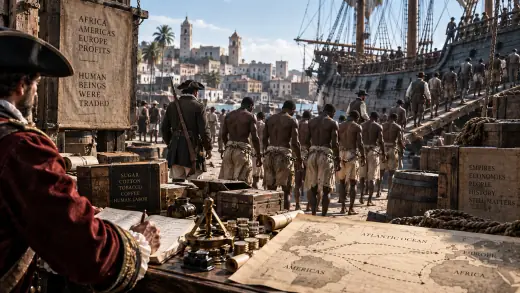
The WIC transported enslaved Africans from West African forts to Brazil, the Caribbean and Spanish America. Amsterdam merchants financed ships, insurance and refining, while colonial plantations turned forced labor into sugar and other exports. Dutch traders also sold captives to other empires. The company’s monopoly did not mean that every voyage was state-run, but Dutch institutions and investors were deeply involved in the Atlantic slave trade. Rijksmuseum: The Dutch West India Company
Suriname became a major Dutch plantation colony after the English transferred it to the Dutch in the Treaty of Breda in 1667. Enslaved Africans worked sugar, coffee and cotton estates under brutal conditions, and Maroon communities resisted through flight and armed struggle. Curaçao, Aruba, Bonaire, Sint Eustatius and other Caribbean possessions supported trade, shipping and slave markets. The Dutch state later inherited territories and obligations that had first been organized through companies.
NEW NETHERLAND AND THE ANGLO-DUTCH WARS
Henry Hudson’s 1609 voyage for the VOC explored the river later named for him. The WIC then established New Netherland, including the settlement of New Amsterdam on Manhattan in 1624. Dutch officials traded and fought with Indigenous nations and competed with English and French colonists. New Amsterdam was captured by England in 1664 and renamed New York. The Dutch briefly recovered it during the Third Anglo-Dutch War, but the Treaty of Westminster in 1674 confirmed the English takeover. Canon of the Netherlands: New Amsterdam
The Dutch Republic and England fought three Anglo-Dutch Wars between 1652 and 1674. Naval battles, convoy protection, privateering and access to colonial markets mattered as much as European diplomacy. English commercial and naval growth eventually reduced Dutch freedom of action, but the rivalry also showed how a republic with a smaller population could mobilize shipping, capital and maritime expertise on a global scale.
William III of Orange became stadtholder after the crisis year of 1672 and later became king of England in the Glorious Revolution of 1688. His personal union with England brought Dutch and English interests into a wider coalition against Louis XIV, but it did not merge the two states. Dutch diplomacy and finance remained important, even as England and France developed larger fiscal-military systems.
DECLINE OF COMPANY DOMINANCE
The VOC did not collapse because one competitor suddenly defeated it. Rising administrative costs, corruption, war with Britain, lower returns on some Asian trades, debt and changing market conditions weakened the company. The VOC was dissolved in 1799, and the Dutch state assumed its territories and liabilities. The WIC had already lost its original commercial monopoly and was dissolved in 1792, although Dutch Atlantic colonies continued under state or semi-state arrangements.
The end of the Dutch Republic in the Batavian era and the creation of the Kingdom of Holland under Louis Bonaparte in 1806 were followed by the Kingdom of the Netherlands in 1815. Colonial government became increasingly direct in the nineteenth century. In the Indonesian archipelago, the Dutch East Indies state expanded through war, treaties and administrative penetration. The Java War, the Aceh War and conflicts elsewhere demonstrate that direct rule was contested rather than peacefully inherited from the VOC.
The Cultivation System introduced in Java in 1830 required villages to devote land and labor to export crops for the colonial government. It generated revenue for the Netherlands while imposing heavy burdens on Indonesian communities. Later reforms and private plantations changed the system, but forced labor, racial hierarchy and unequal land access remained central to colonial rule. Dutch infrastructure, education and commercial agriculture cannot be separated from coercion and the extraction of local resources.
SLAVERY, ABOLITION AND DECOLONIZATION
The Netherlands abolished slavery in Suriname and the Dutch Caribbean in 1863, although formerly enslaved people were required to continue plantation labor under state supervision for a further period. Slavery had also existed in the VOC world, at the Cape, in Ceylon and in Southeast Asian ports. Abolition did not erase racial inequality or colonial control. Contract laborers from India and Java later worked in Suriname under restrictive conditions, showing how post-emancipation systems could preserve exploitation in new legal forms.
Indonesian nationalists declared independence in 1945 after the Japanese occupation. The Netherlands fought to restore colonial authority and then accepted Indonesian sovereignty in 1949 after international pressure and armed conflict. Suriname became independent in 1975. The Netherlands retained Caribbean countries and municipalities with changing constitutional relationships, so decolonization did not produce one identical outcome everywhere.
Colonial archives and objects remain part of public debate. Museums such as the Rijksmuseum document how collections were acquired through unequal power, conquest and forced labor, and the Dutch government has developed restitution policies for some colonial objects. These efforts do not settle every historical claim, but they show why the empire’s legacy is an active question rather than a closed chapter. Rijksmuseum: Colonial provenance research
LEGACY OF THE DUTCH EMPIRE
The Dutch Empire left ports, canals, archives, legal records, buildings, languages and commercial connections across several continents. Amsterdam’s financial techniques influenced later capitalism, while Dutch charts, botanical collections and scientific instruments expanded European knowledge. These achievements were produced in an imperial setting. Knowledge moved through colonial networks, and the people who supplied commodities or served in ships and armies rarely shared the profits equally.
The empire was never one uniform structure. The Dutch Republic governed through provinces and companies, the VOC and WIC combined private investment with public violence, and the nineteenth-century Kingdom of the Netherlands created more centralized colonial administrations. In Asia and the Atlantic, direct rule, treaty relationships, company monopolies, plantations and military occupation existed side by side.
A historical account must therefore hold two truths together. Dutch merchants and officials built sophisticated global networks, supported extraordinary art and science, and helped make Amsterdam a world city. The same networks depended on forced labor, slavery, land seizure and violence in the Banda Islands, Java, southern Africa, the Atlantic and the Caribbean. The empire’s continuing legacy lies in both its material connections and the unequal histories those connections produced.
FREQUENTLY ASKED QUESTIONS
**Was the VOC the Dutch government?**
No. The VOC was a chartered company, but the States General granted it powers to make treaties, build forts, appoint officials and wage war. Its rule could therefore look governmental while remaining accountable to company directors and shareholders.
**What happened in the Banda Islands?**
In 1621 the VOC used military force after Bandanese communities resisted its spice monopoly. Many people were killed, expelled or enslaved, and the islands were reorganized into guarded nutmeg plantations. The event is a central example of colonial violence in the VOC era.
**Did the Dutch Empire depend on slavery?**
Yes. Enslaved labor supported plantations, households, ports and company operations in the Atlantic, the Cape, South Asia and Southeast Asia. The WIC transported enslaved Africans, while the VOC and colonial authorities also enslaved and displaced people in the Indian Ocean world.
**Was New Amsterdam the same as New York?**
New Amsterdam was the Dutch settlement on Manhattan within New Netherland. England captured it in 1664 and renamed it New York. Dutch influence remained visible in names, architecture and records, but the colony became English under the later treaties.
**When did the Dutch Empire end?**
There was no single ending. The VOC disappeared in 1799, direct colonial rule expanded in the nineteenth century, Indonesia became independent in 1949 and Suriname in 1975, while the Netherlands retained Caribbean territories under changing constitutional arrangements.
SOURCES AND FURTHER READING
For related imperial histories, see PRESDA’s Russian Empire, Swedish Empire and Kingdom of Sicily articles.
> The Dutch Empire joined finance and maritime skill to company rule, conquest and coerced labor across several continents.
FAQ
Frequently Asked Questions
Was the VOC the Dutch government?
No. The VOC was a chartered company, but the States General granted it powers to make treaties, build forts, appoint officials and wage war.
What happened in the Banda Islands?
In 1621 the VOC used military force after Bandanese communities resisted its spice monopoly. Many people were killed, expelled or enslaved, and the islands were reorganized into guarded nutmeg plantations.
Did the Dutch Empire depend on slavery?
Yes. Enslaved labor supported plantations, households, ports and company operations in the Atlantic, the Cape, South Asia and Southeast Asia.
Was New Amsterdam the same as New York?
New Amsterdam was the Dutch settlement on Manhattan. England captured it in 1664 and renamed it New York.
When did the Dutch Empire end?
There was no single ending. The VOC disappeared in 1799, Indonesia became independent in 1949 and Suriname in 1975, while the Netherlands retained Caribbean territories under changing constitutional arrangements.
PRESDA Dispatch
Stay Informed. Stay Aware.
A sharp briefing across AI, gaming, sport, business, world affairs, paparazzi, and lifestyle.