GREAT ZIMBABWE: THE AFRICAN KINGDOM BUILT IN STONE
Between the eleventh and fifteenth centuries, Shona ancestors built Great Zimbabwe into a powerful southern African center of farming, cattle keeping, craft production and Indian Ocean trade.
Great Zimbabwe was a major Shona settlement and political center in southeastern Africa, near present-day Masvingo in Zimbabwe. Between the eleventh and fifteenth centuries, its rulers organized farming, cattle keeping, craft production and long-distance trade from a landscape of granite hills and open savanna. The city was built by African communities whose descendants speak Shona languages. It is not the same thing as the modern Republic of Zimbabwe, although the modern country took its name and a powerful national symbol from the ruins.
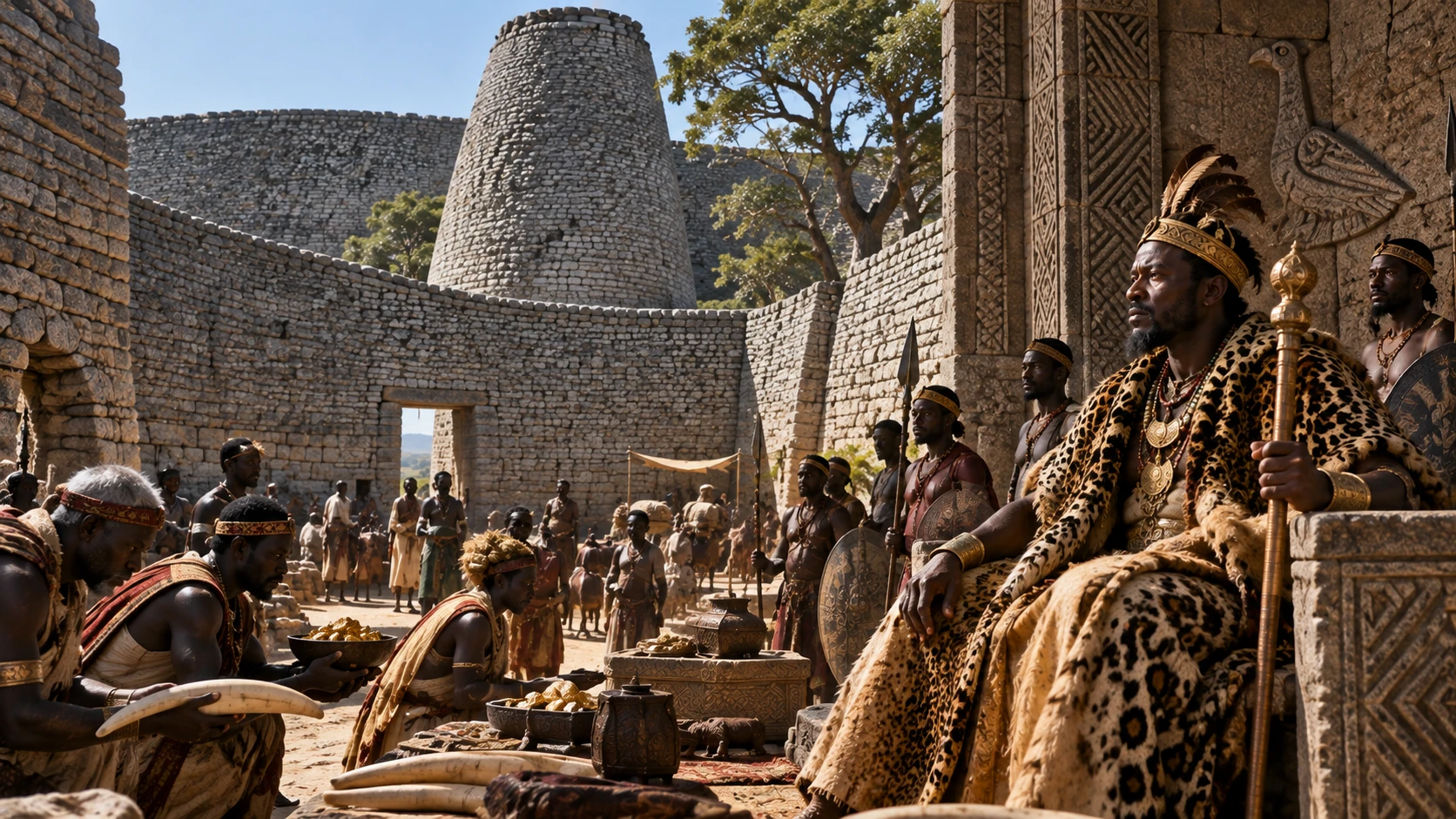
Great Zimbabwe is famous for walls built from carefully shaped granite blocks without mortar. Its builders created monumental spaces for residence, ceremony, defense and political display, but the ruins do not reveal every detail of their institutions. Population estimates, the exact role of each enclosure and the reasons for the site's decline remain debated. The strongest evidence comes from archaeology, architecture, environmental research and material recovered from the settlement.
A SHONA STATE ON THE ZIMBABWE PLATEAU
The ancestors of today's Shona-speaking peoples lived in a region with long traditions of farming, cattle keeping, ironworking and settlement. Great Zimbabwe grew from earlier communities rather than appearing suddenly. Archaeologists identify a sequence of occupations that developed from the first millennium into the later Iron Age, when rulers concentrated labor and resources at the site. The word zimbabwe is related to Shona terms for a stone house or revered settlement, though its historical uses were varied.
The site stands on a granite ridge and surrounding valleys in the highveld of southeastern Africa. Its builders selected local stone that could be split into regular blocks and stacked in stable courses. The walls use gravity, friction and carefully chosen stone shapes rather than cement or mortar. This technique required skilled quarrying, transport and maintenance. It was part of a wider regional building tradition that included many smaller stone-walled settlements, while Great Zimbabwe was exceptional in scale and monumentality. UNESCO: Great Zimbabwe National Monument
Great Zimbabwe flourished from roughly the eleventh century and reached its greatest influence between the thirteenth and fourteenth centuries. It was not a modern centralized nation-state with surveyed borders. Its rulers likely exercised authority through tribute, kinship, ritual leadership, control of cattle and access to trade. Political influence extended across a network of communities rather than through uniform administration of every distant settlement.
THE HILL COMPLEX, GREAT ENCLOSURE AND VALLEY RUINS
The Hill Complex rises above the surrounding landscape and includes terraces, platforms, retaining walls and enclosures. Earlier interpretations called it a fortress, but its functions were probably mixed. Elevated spaces could support ritual activity, elite residence, political audiences and visual control of the valley. The location also connected the ruling center to the broader settlement below.
The Great Enclosure is the most famous monument. Its curved outer wall extends for hundreds of meters and reaches impressive heights in places, creating a monumental boundary without defensive loopholes or a roof. Within it are passageways, platforms, living spaces and the Conical Tower. The tower is carefully built and visually dominant, but archaeologists cannot prove whether it represented a granary, a royal symbol, a ritual structure or another kind of political monument. Its meaning must be inferred cautiously from its position and design.
The Valley Ruins include a large number of walls and enclosures spread through the valleys around the hill. They show that Great Zimbabwe was not just a single palace or isolated fortress. Households, workshops, storage areas and elite compounds occupied a wider urban landscape. Differences in wall scale, location and associated artifacts suggest social distinctions, although the exact hierarchy of residents remains difficult to reconstruct.
The walls were not simply barriers. Their curved lines, chevron and herringbone patterns, narrow passages and controlled views shaped movement through the site. Architecture made social rank visible. Visitors approaching an elite area encountered stone, height and restricted access before reaching the people who controlled ceremonies, resources and decisions.
KINGS, ELITES, FARMERS AND CATTLE
Great Zimbabwe's political economy rested on ordinary production as much as on royal display. Farmers cultivated grains and other crops suited to the plateau, while cattle supplied meat, milk, hides and wealth that could be exchanged or redistributed. Herds also carried social and political meaning. A ruler who could command cattle and organize labor could reward followers, support ritual specialists and maintain alliances.
Elites probably lived in compounds distinguished by location, architecture and access to imported objects. Craft workers produced iron tools, weapons, ornaments, pottery and soapstone carvings. Gold working and other metalworking required technical knowledge and links to mining areas. The presence of specialized production does not mean every object was made for a palace. Archaeology suggests a society with different households and occupations, linked through tribute and exchange.
Scholars have proposed that Great Zimbabwe housed several thousand people and supported a larger regional population, while some older accounts suggested much higher numbers. Estimates depend on how densely houses were occupied, how much of the settlement has disappeared and whether surrounding communities are counted. It is safer to say that the site was a substantial urban center whose influence exceeded the walls that survive today, without presenting one population figure as settled fact.
GOLD, IVORY AND THE INDIAN OCEAN NETWORK
Great Zimbabwe occupied a strategic position within routes connecting the interior to the east African coast. Gold from the Zimbabwe plateau and nearby regions, ivory, animal products and other goods moved toward trading towns on the Indian Ocean. Coastal merchants exchanged cloth, beads, ceramics and metal goods. The network linked southern Africa to ports such as Kilwa and to commercial worlds reaching Arabia, Persia, India and China.
Archaeological finds make those connections visible. Excavations recovered imported glass beads, glazed ceramics, Chinese porcelain, Persian wares and coins associated with Kilwa. These objects were not proof that foreigners built the city. They show that African rulers and merchants participated in a maritime economy and that imported goods moved inland through African-controlled routes. UNESCO: Great Zimbabwe archaeological evidence
Gold was important, but Great Zimbabwe was not a mythical warehouse containing all the region's wealth. Gold production was distributed across landscapes and involved miners, traders and political authorities beyond the capital. Ivory and cattle were also valuable, and farming sustained the communities that made long-distance commerce possible. The power of the state came from coordinating production, labor, tribute and exchange.
Metalworking left evidence of iron tools, weapons and ornaments, while soapstone carving produced vessels, beams and the famous Zimbabwe Birds. Local production and imported goods existed together. The city was deeply connected to the Indian Ocean without becoming a foreign colony or an outpost directed from the coast.
THE ZIMBABWE BIRDS AND POLITICAL MEANING
Eight soapstone birds are associated with Great Zimbabwe, although not all remain at the site today. The carvings combine human or animal forms with long-legged birds, often identified cautiously with the bateleur eagle or another raptor. Their exact meaning is unknown. They may have represented royal authority, ancestors, spiritual power or a connection between the elevated Hill Complex and the wider community.
The birds were found in elite or ritual contexts and later became among the most recognizable symbols of Zimbabwe. Their significance cannot be reduced to one proven interpretation. They may have carried several meanings at once, linking political leadership to sacred landscapes and ancestral memory. Modern Zimbabwe incorporated the bird into national emblems, giving an ancient sculpture a new public life.
ARCHAEOLOGY AND THE FIGHT AGAINST COLONIAL MYTHS
When European settlers and antiquarians encountered Great Zimbabwe, many refused to accept that African societies had built such sophisticated stone architecture. They proposed foreign builders, including Phoenicians, Arabs, ancient Egyptians or biblical figures. The Queen of Sheba and King Solomon were repeatedly invoked as explanations, but there is no archaeological evidence that they built Great Zimbabwe. These claims were not innocent guesses. They supported colonial ideologies that denied African historical achievement.
Early investigations often removed objects and damaged parts of the site while searching for evidence of a foreign origin. David Randall-MacIver's 1905 work and Gertrude Caton-Thompson's 1929 to 1931 excavations helped establish that the architecture and material culture belonged to an indigenous African Iron Age tradition. Later radiocarbon dating, local pottery sequences, settlement patterns and regional comparisons strengthened that conclusion. Archaeology did not simply discover an African origin; it also had to overcome institutions that had worked to obscure it. Cambridge Archaeological science and globalisation project
The evidence is now clear on the central point. Great Zimbabwe was built by African communities related to the ancestors of Shona-speaking peoples. This conclusion does not require exaggerating the site's size or claiming that every unanswered question has been solved. It rests on the relationship between local materials, regional architecture, settlement history and the absence of evidence for the proposed foreign builders.
WHY GREAT ZIMBABWE DECLINED
By the fifteenth century, Great Zimbabwe's political importance was declining. No single cause explains the change. Environmental pressure, shifting rainfall, soil and water constraints, the demands of supporting a large settlement, changing cattle economies and the movement of trade routes may all have played roles. Political competition could have encouraged rulers and communities to relocate toward new centers.
The decline was not an abrupt disappearance. People continued to live in the region, reuse stone and maintain connections with other Zimbabwe Culture sites. The rise of Khami in southwestern Zimbabwe and the Mutapa state farther north reflects a wider reorganization of power. Khami developed its own decorated walls and elite compounds, while Mutapa controlled important territories and trade routes in the northeastern plateau. Later Portuguese records describe parts of this changing political world, but they do not provide a complete account of Great Zimbabwe's earlier history.
Great Zimbabwe's abandonment as a major center therefore belongs to a sequence of transformations rather than a single disaster. Communities, technologies and political traditions continued after the court moved elsewhere. UNESCO: Khami Ruins
FROM GREAT ZIMBABWE TO MODERN ZIMBABWE
The name Zimbabwe became a statement of African sovereignty. During the colonial period, the territory was called Southern Rhodesia and later Rhodesia. Nationalist movements reclaimed Zimbabwe, drawing on the stone city as evidence of a deep African history. When independence came in 1980, the new republic adopted Zimbabwe as its name, linking modern citizenship to the heritage of Great Zimbabwe while building a state that is not identical to the medieval city or its political system.
Great Zimbabwe was inscribed as a UNESCO World Heritage Site in 1986. Conservation has to balance tourism, the stability of dry-stone walls, vegetation and the rights of local communities connected to the landscape. The monument is both an archaeological site and a living national symbol. Its value lies not only in the height of its walls but in the historical knowledge they preserve about African labor, authority, craft and global connection.
Great Zimbabwe's legacy also belongs within the wider history of African states. Like the Ghana Empire and the Ethiopian Empire, it grew through local institutions connected to wider commerce and political networks. Its builders were not mysterious outsiders. They were African engineers, farmers, artisans, traders, rulers and ritual specialists who created a city whose stone architecture still challenges the old colonial habit of looking elsewhere for African achievement.
FREQUENTLY ASKED QUESTIONS
**Where was Great Zimbabwe located?**
Great Zimbabwe was located in southeastern Africa near modern Masvingo in Zimbabwe, on a granite plateau between the highveld and the routes leading toward the Indian Ocean coast.
**Who built Great Zimbabwe?**
African communities related to the ancestors of Shona-speaking peoples built and occupied Great Zimbabwe. Archaeology identifies it as an indigenous Iron Age southern African center, not a city built by foreigners or biblical figures.
**What is the Great Enclosure?**
The Great Enclosure is the largest monumental complex at Great Zimbabwe. Its dry-stone walls, internal passages and Conical Tower created a powerful setting for elite residence, ceremony and political display, although the exact function of each feature remains uncertain.
**Did Great Zimbabwe trade with China and the Indian Ocean?**
Yes. Imported glass beads, Chinese and Persian ceramics, and coins associated with Kilwa show that Great Zimbabwe participated in long-distance trade through African routes connecting the interior to the Indian Ocean.
**Why did Great Zimbabwe decline?**
The decline during the fifteenth century probably had several causes, including environmental pressure, changing trade routes, cattle and resource demands, and political reorganization. It was not a single event with one proven explanation.
**Why is Great Zimbabwe important to modern Zimbabwe?**
The modern country took its name from the Shona term associated with stone houses or settlements at Great Zimbabwe. The ruins became a symbol of African historical achievement and national sovereignty, and the site was listed by UNESCO in 1986.
> Great Zimbabwe's walls are evidence of African engineering, political imagination and connections across the Indian Ocean.
FAQ
Frequently Asked Questions
Who built Great Zimbabwe?
African communities related to the ancestors of Shona-speaking peoples built and occupied Great Zimbabwe. Archaeology identifies it as an indigenous Iron Age southern African center, not a city built by foreigners or biblical figures.
What is the Great Enclosure?
The Great Enclosure is the largest monumental complex at Great Zimbabwe. Its dry-stone walls, passages and Conical Tower created a setting for elite residence, ceremony and political display, although exact functions remain uncertain.
Did Great Zimbabwe trade with China and the Indian Ocean?
Yes. Imported glass beads, Chinese and Persian ceramics, and coins associated with Kilwa show that Great Zimbabwe participated in long-distance trade through African routes connecting the interior to the Indian Ocean.
Why did Great Zimbabwe decline?
Its fifteenth-century decline probably had several causes, including environmental pressure, changing trade routes, cattle and resource demands, and political reorganization.
Why is Great Zimbabwe important to modern Zimbabwe?
The modern country took its name from the Shona term associated with stone houses or settlements at Great Zimbabwe. The ruins became a symbol of African historical achievement and national sovereignty.
PRESDA Dispatch
Stay Informed. Stay Aware.
A sharp briefing across AI, gaming, sport, business, world affairs, paparazzi, and lifestyle.