SEX EDUCATION: BEYOND THE TABOO
What WHO, UNESCO and UNICEF say about age-appropriate sex education, consent, puberty, contraception and misinformation, including the limits of the evidence.
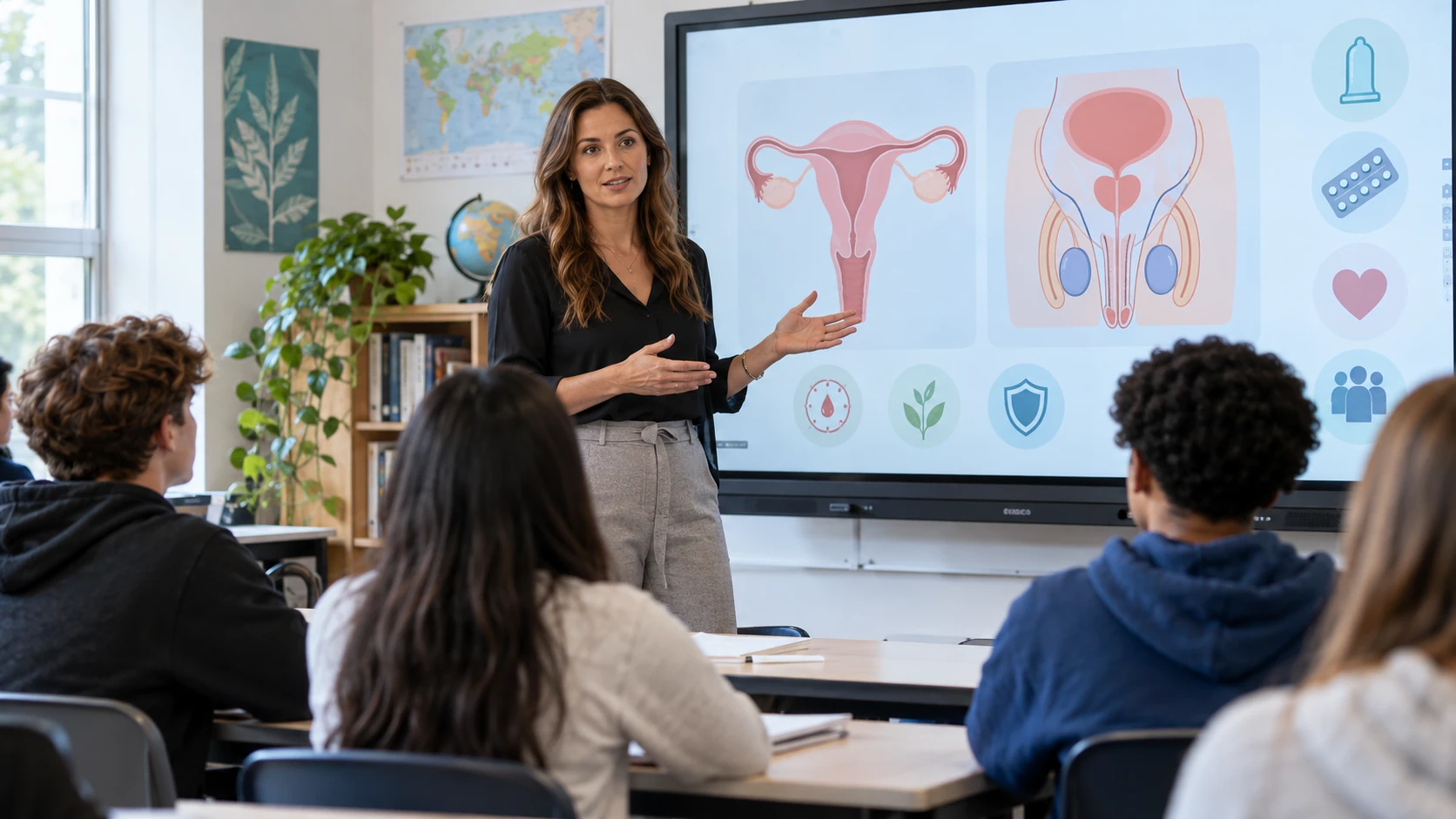
AI-generated editorial illustration of a classroom health lesson; the diagrams are illustrative, not medical reference images.
Imagine a young person holding a question back until the classroom empties. Is this change in my body normal? Can I say no to someone I love? Is the advice on my phone true? The questions are ordinary. What makes them difficult is the possibility that asking will invite embarrassment, punishment or silence. Sex education begins long before a lesson about reproduction: it begins with whether a question can be asked safely.
That is the tension behind the taboo. Families may want to protect children from information they consider premature, while young people already encounter fragments of it through friends, advertising and screens. The choice is rarely between information and no information. It is between information that can be questioned and checked, and information acquired without a reliable guide.
More than a lesson about sex
Comprehensive sexuality education is structured, scientifically accurate learning about bodies, relationships and sexual and reproductive health, adapted to age and development. WHO includes puberty, consent, respect, pregnancy prevention and infections within its scope. Its purpose is to support informed decisions, not prescribe when someone should become sexually active. WHO: definition and scope
This makes the subject both practical and relational. Knowing a body part’s name is different from understanding how to ask for care. Knowing that consent matters is different from recognizing pressure in a relationship. A useful curriculum connects facts with communication, judgment and opportunities to seek help. It also leaves room for a person to choose not to have sex, without treating that choice as a reason to withhold health information from everyone else.
What the evidence actually establishes
UNESCO, UNICEF and WHO contributed to the same 2018 international technical guidance, alongside other UN agencies. These are not three independent clinical trials. Their guidance synthesizes research and proposes learning objectives. UNESCO’s evidence summary does not support the claim that comprehensive education accelerates sexual activity; well-designed programs can support later initiation and safer behavior. Results depend on what is taught and how well it is delivered. Joint UN guidance UNESCO: evidence overview
The limitations are equally important. A 2016 Cochrane review included eight trials involving 55,157 adolescents and examined pregnancy and infection outcomes rather than knowledge alone. It found little evidence that the educational programs by themselves reduced STIs or adolescent pregnancy. That does not show that every curriculum is ineffective. It shows why improved knowledge, self-reported behavior and measurable health outcomes must not be treated as interchangeable. Education needs accessible services and practical support. Cochrane review
The gap between policy and experience is also substantial. A 2021 global status report found that 85% of 155 surveyed countries had policies or laws relating to sexuality education. This is a dated measure of policy coverage, not proof that 85% of children received comprehensive, high-quality lessons. A curriculum on paper cannot tell us whether teachers are trained, students feel safe, or vulnerable young people are reached. Global status report
Puberty without shame, anatomy without mystery
The first useful lesson may be reassurance that development varies. Puberty changes bodies and emotions, but it does not follow an identical timetable for everyone. Accurate anatomical language allows people to describe discomfort, ask questions and understand healthcare. Teaching should distinguish biological processes from assumptions about how a person must look, behave or identify.
Reproductive literacy includes understanding that ovaries can release eggs, sperm may fertilize an egg, and the uterine lining changes during the menstrual cycle. Cycles vary; a calendar is not a guarantee of a pregnancy-free day. Basic biology should replace myths rather than create a new false certainty. Persistent symptoms or individual concerns belong in a conversation with a qualified clinician. NHS: menstrual cycle and fertility
Menstruation offers a revealing example of the difference between information and readiness. A young person can know that periods exist yet feel frightened when the first one arrives. UNICEF’s guidance encourages conversations at home and treating menstruation as an ordinary subject rather than a secret. Boys also benefit from understanding it. Education becomes useful when knowledge is accompanied by products, privacy and someone who will listen. UNICEF: talking about periods
Consent is a relationship skill
Consent is freely given agreement, not the absence of a struggle. It must be possible to change one’s mind without threats or punishment. A relationship, a gift or previous intimacy does not create a permanent entitlement to another person’s body. Laws governing age and capacity differ by jurisdiction; an educational article cannot replace local legal guidance.
For younger children, the foundations are everyday boundaries, privacy and knowing which trusted adults can help. This is not adult sexual instruction. Crucially, teaching boundaries never transfers responsibility for abuse to a child. Adults and institutions remain responsible for protection. With adolescents, discussion can address coercion, unequal power and how to respond when a friend discloses harm. WHO: age-appropriate protection
Healthy relationships also require room for independence. Demanding passwords or constant proof of loyalty should not be romanticized as care. PRESDA’s exploration of jealousy and suspicion examines how insecurity can become controlling behavior. Sex education can help people name that difference before a relationship’s rules become harder to question.
Prevention needs knowledge and access
Contraception is not a single solution that suits every body or circumstance. Methods differ in how they work, how they are used, their side effects and suitability. A healthcare professional can help someone compare options. Condoms offer protection against both pregnancy and many STIs, while other contraceptive methods do not protect against infections. Protection is not absolute, and correct, consistent use matters. WHO: family planning
Infections cannot reliably be judged by appearance or symptoms. WHO estimated 374 million new infections with four curable STIs in 2020: chlamydia, gonorrhoea, syphilis and trichomoniasis. This counts infections, not necessarily 374 million different people, and is not a count for the current year. Many infections are asymptomatic. Testing and appropriate treatment therefore matter even when someone feels well; stigma can make asking for them unnecessarily difficult. WHO: STI estimates
Emergency contraception is another subject surrounded by confusion. Emergency contraceptive pills prevent or delay ovulation; they do not interrupt an established pregnancy. They are not the same as abortion medication. If protection fails or sex occurs without contraception, prompt advice from a pharmacist or healthcare service is more useful than a social-media remedy. Timing and the suitable option should be discussed with a professional. WHO: emergency contraception
Growing up with the conversation
Age-appropriate education is a sequence, not a single dramatic conversation. Early childhood can focus on body vocabulary, privacy, feelings and help-seeking. Before puberty, children need explanations of bodily changes. Adolescents need progressively fuller information about relationships, contraception, infections and digital pressures. The UN guidance organizes objectives into developmental age bands, allowing local adaptation rather than giving identical material to every learner. International technical guidance
Adulthood does not end the need to learn. A new relationship, parenthood, fertility concerns or menopause can bring unfamiliar questions. People with disabilities also need accessible information rather than assumptions that relationships do not concern them. Good educational design asks who cannot hear, read, understand or safely discuss the material, and adjusts the format accordingly. An inclusive lesson makes help easier to find, not everyone’s private life a classroom topic.
The phone has become an unofficial teacher
Pornography is produced entertainment, not a dependable guide to consent, anatomy or ordinary relationships. Discussing that distinction does not require showing explicit material. Students can learn to question edited images, commercial incentives and unrealistic expectations, and to seek support if they encounter disturbing content. The aim is media literacy, not humiliation or an assumption that every viewer has the same experience. UN guidance on media literacy
UNICEF’s research on digital misinformation addresses a wider information environment, not a trial proving that one platform causes a particular sexual behavior. Its relevance is the need for critical skills and shared responsibility among families, educators and platforms. A useful habit is to ask who made a claim, what evidence supports it, whether it sells something, and whether an authoritative health source agrees. A confident video is not a clinical qualification. UNICEF Innocenti: digital misinformation
Culture is part of the conversation
Religious and cultural concerns should be heard in their actual diversity. Neither faith communities nor secular societies speak with one voice. People may disagree about relationships and still share commitments to protecting children, preventing illness and treating others with dignity. Respectful education can explain scientific facts while distinguishing them from moral beliefs and local law. Respect does not require endorsing medical misinformation.
UNICEF’s Pacific parenting materials illustrate an approach built around family communication: caregivers are encouraged to discuss puberty and reproductive health accurately, including fathers and male caregivers. UNICEF’s European and Central Asian guidance on periods similarly brings a potentially embarrassing subject into ordinary family life. These are examples of educational approaches, not comparative proof that one region has solved the problem. UNICEF: Pacific parenting UNICEF: periods at home
Parents, teachers and clinicians have different jobs
Parents can offer continuity, values and a trusted relationship. Teachers can provide a structured curriculum and correct shared misconceptions. Clinicians can answer individual health questions, explain options and provide care. None should assume that the other has already covered everything. A parent who admits uncertainty and finds a reliable answer models a better habit than one who invents certainty. UNICEF: parenting guidance
Schools also need practical safeguards: trained staff, anonymous question options and clear routes to support. Students should not be required to disclose intimate experiences publicly. Confidentiality needs an honest explanation, including any safeguarding duties that may limit it. An effective lesson creates permission to ask for help without promising secrecy that a professional cannot legally keep.
Myths that deserve better answers
The idea that education necessarily encourages early sex is not supported by UNESCO’s evidence overview. The idea that a lesson alone can solve pregnancy and infection risk goes beyond the Cochrane findings. And the idea that every child should receive the same information ignores developmental differences. Scientific balance means rejecting both alarmism and exaggerated promises. UNESCO: evidence Cochrane: limitations
Choosing abstinence can be a meaningful personal decision. It is different from an educational policy that supplies no information about contraception, infections or consent. Likewise, knowing biological facts does not make someone immune to pressure. Education is most credible when it gives people tools while acknowledging the social conditions that can limit their choices.
Beyond the taboo
The deepest achievement of sex education may be modest: a question asked before fear becomes isolation, a boundary spoken without apology, a medical concern brought to someone who can help. It cannot remove every risk or settle every disagreement about intimacy. It can make the difference between uncertainty endured alone and uncertainty met with accurate information.
A society does not have to agree on every private choice to agree that people deserve truthful answers about their bodies. Beyond the taboo lies neither a command to experiment nor a demand to confess. There is simply the possibility of learning without shame, and making decisions with greater understanding.
FAQ
Frequently Asked Questions
What is this PRESDA article about?
What WHO, UNESCO and UNICEF say about age-appropriate sex education, consent, puberty, contraception and misinformation, including the limits of the evidence.
Which category does this story belong to?
This story is part of PRESDA's Lifestyle coverage.
Who published this article?
SEX EDUCATION: BEYOND THE TABOO was published by PRESDA Editorial on PRESDA.
PRESDA Dispatch
Stay Informed. Stay Aware.
A sharp briefing across AI, gaming, sport, business, world affairs, paparazzi, and lifestyle.