CHINA’S 151-ROBOT DANCE: THE REPORTED GUINNESS RECORD EXPLAINED
Reports describe a November 17, 2026 dance by 151 humanoid robots in Shenzhen. The Guinness category, participating hardware and limits explained.
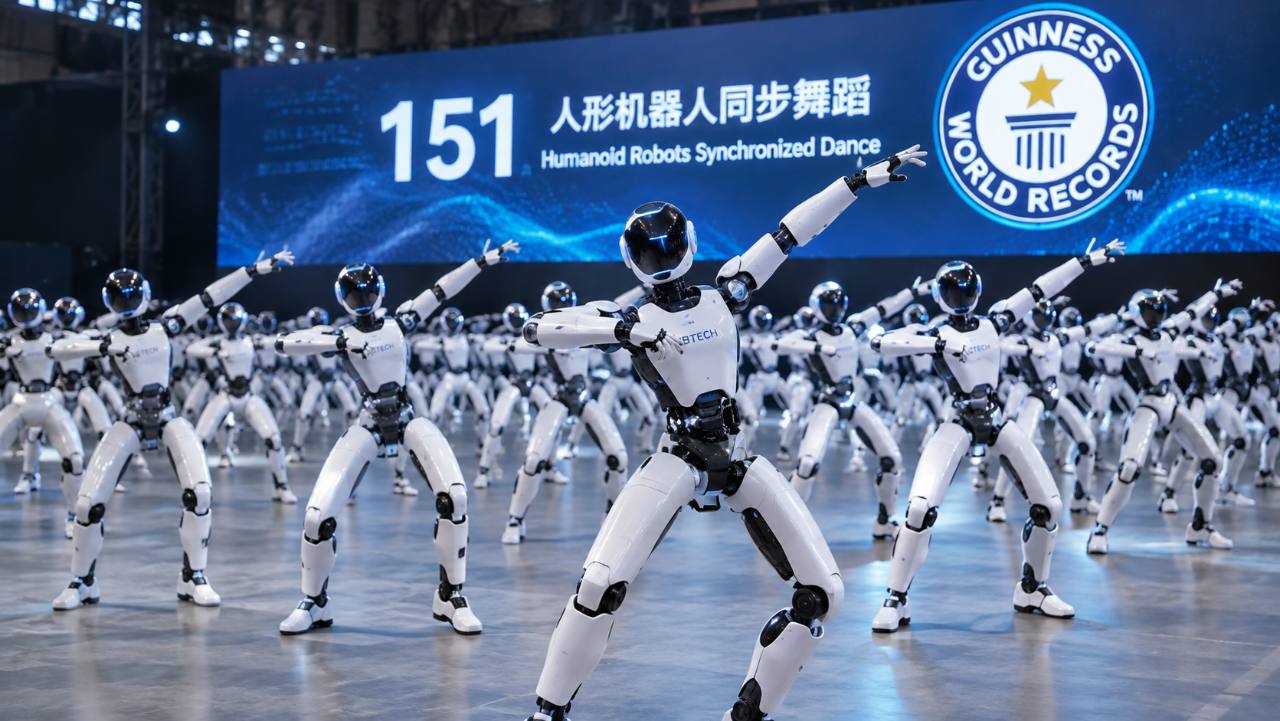
Original supplied editorial visual, preserved unchanged. Its event provenance and the participant count shown in its graphics have not been independently authenticated.
A public square in Shenzhen became a stage for a striking robotics demonstration on November 17, 2026. Reports described 151 humanoid robots performing a coordinated dance, with EngineAI’s full-size T800 among the machines involved. CBS footage carried by KYMA the following day presented the event as a Guinness World Record achievement. CBS footage via KYMA: November 17 performance reported November 18
The number is clear in the reporting; the record’s exact classification requires more care. Gasgoo described a challenge for the most humanoid robots dancing simultaneously within one hour. PRESDA could not independently match the event to a public Guinness database entry at publication, so the headline attributes the record status to the reports rather than presenting a separately verified Guinness certification. Gasgoo: reported one-hour record category and organizers
| Question | Reported position |
|---|---|
| Event date | November 17, 2026 |
| Location | Longgang district, Shenzhen, China |
| Count | 151 successful participants, according to event reporting |
| Record status | Reported Guinness achievement; exact public database entry not independently matched at publication |
What happened in Shenzhen?
The event took place in Shenzhen’s Longgang district, according to Gasgoo, which identified a coalition led by the district’s artificial intelligence and robotics bureau and involving the robot 6S store, EngineAI and other robotics businesses. Its account said an on-site adjudicator announced 151 successful participants. That is an attributed description of the challenge, not a measurement independently conducted by PRESDA. Gasgoo: reported one-hour record category and organizers
VnExpress’s November 19 report adds an important hardware distinction: it says 20 T800 robots participated, alongside machines from companies including Unitree and AgiBot. The event should therefore not be summarized as “151 T800 robots.” A mixed group of humanoids can contribute to a single demonstration without every machine being the same model or coming from the same manufacturer. VnExpress: participating companies and 20 T800 robots
Why the category wording matters
Guinness records are defined by rules, not only by an impressive-looking number. A count across a specified period, a count of machines moving at exactly the same moment and a category restricted to humanoid robots can represent different tests. Without the category rules, comparing headline totals can give a false impression of which achievement is larger or more demanding.
That is especially relevant here because reports use both “synchronized” and a one-hour qualification. The observed dance and the reported total can be described clearly while retaining that uncertainty about the formal record wording. A newsroom should not silently remove a qualification that may determine how participants were counted.
A hundred-plus dance is not the first robot dance record
Guinness’s broader page for the most robots dancing simultaneously documents a different category involving small Alpha 1S robots. Its description identifies machines less than 40 centimeters tall. The existence of that category is enough to show why 151 full-size humanoids should not be advertised as the largest gathering of every kind of dancing robot in history. Guinness World Records: separate most-robots-dancing category
The Jinan government also reported an October 24, 2026 performance by 110 AgiBot Expedition A3 humanoids. That earlier event provides useful context for the rapid succession of public demonstrations. It should not automatically be treated as a directly comparable previous record until the counting conditions and formal category are established as equivalent. Jinan government: October 24, 2026 humanoid dance report
What can be compared responsibly?
A useful comparison begins with the machines, the rules and the setting. Are the participants similarly sized? Must every unit finish the routine? How long must the performance last? Are fallen or inactive robots removed from the total? Those questions make a record intelligible, rather than reducing it to the highest number printed above a crowd.
The Shenzhen reports establish a large public demonstration and identify the participating industry. They provide less detail about the underlying validation and control architecture. That boundary should remain visible. The event can be impressive without being used as proof of technical capabilities that the reporting does not measure.
Why coordinated movement is an engineering task
A humanoid robot has to manage its own body while moving. Joint commands, balance, timing and the interaction of feet with the surface all matter. Asking many machines to perform in formation adds another layer: their movements have to remain compatible with neighboring robots and with the space available. A routine that looks simple to a spectator can demand careful preparation.
The importance of a demonstration is not only whether a robot can produce one pose. It is whether motion can be repeated consistently through a sequence. With multiple machines, a small difference in timing or position can become visually obvious. Coordination is therefore a meaningful subject of engineering, even when the performance is designed primarily as a public spectacle.
Choreography does not establish general intelligence
Robots can be coordinated through several approaches, including prepared motion sequences and supervisory control. A dance video alone does not reveal which parts are preprogrammed, which depend on feedback and which decisions are made independently during the performance. It also does not show how the same machines would behave in an unfamiliar, crowded environment with unscripted obstacles.
This is a question of evidence rather than a dismissal of the hardware. A successful routine demonstrates the routine under its conditions. Broader claims about autonomous reasoning, household usefulness or safe deployment require additional tests designed for those purposes. The event’s reported record status does not substitute for those separate forms of evaluation.
Understanding the machines behind the spectacle
Unitree’s official G1 page illustrates how a manufacturer describes humanoid capability through a specific model, its configuration and development platform. Such product information is useful for understanding the hardware category, but specifications for one robot should not be assigned to every machine in a mixed fleet. The Shenzhen reports do not justify treating all 151 participants as technically identical. Unitree: official G1 product specifications
The supporting photograph shows a Unitree G1 at a 2024 exhibition. It is included as genuine hardware context, with its date and source visible. It does not document the November 2026 dance or establish that the individual robot photographed took part. The supplied hero is likewise preserved as an editorial visual, not as independently authenticated evidence of the final count.
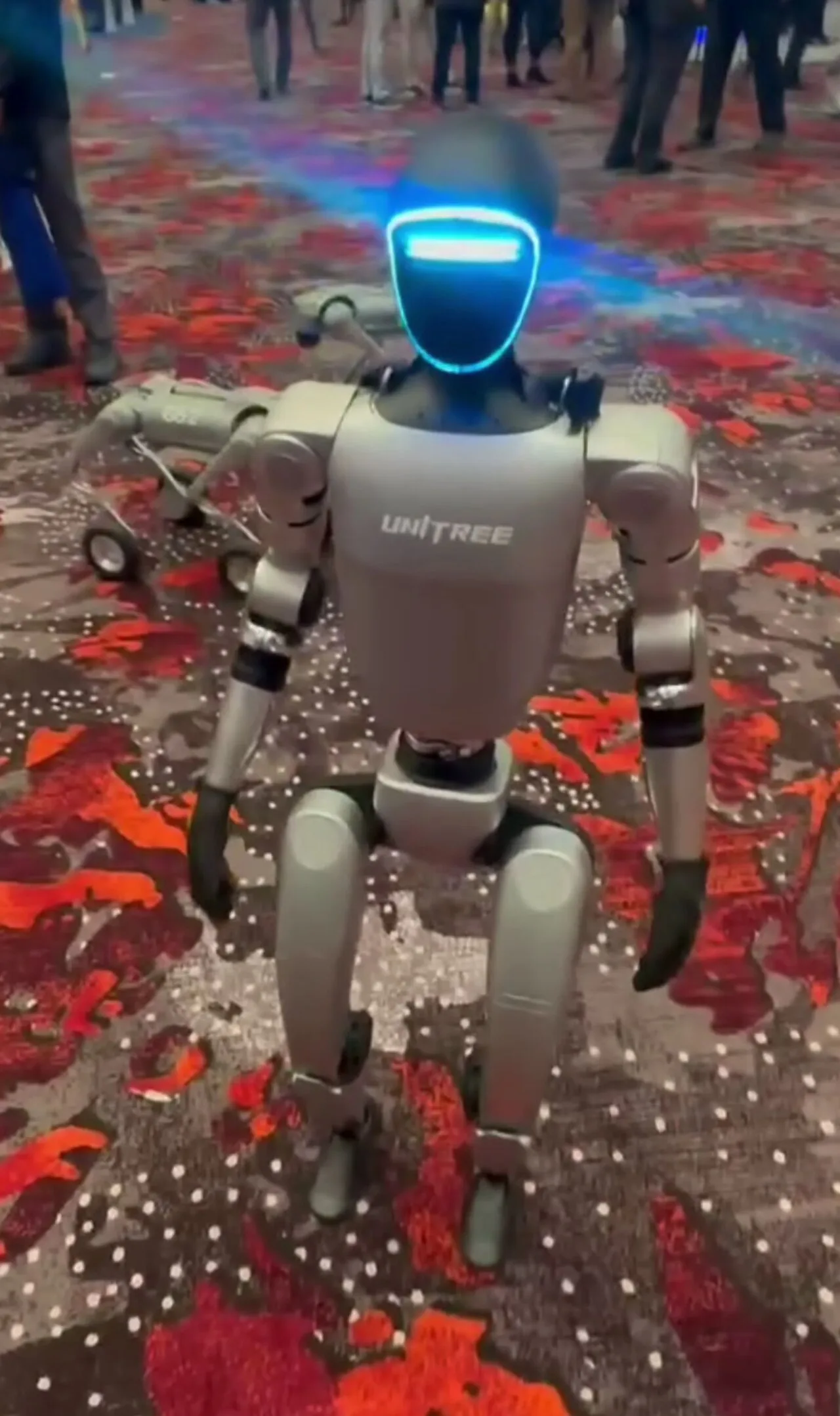
Unitree G1 at UAV Expo, November 18, 2024. An authentic hardware-context photograph, not an image of the November 2026 dance or proof that this individual unit participated.
PRESDA’s article on humanoid robot news anchors examines another public-facing use of human-shaped machines. Both stories benefit from identifying the task being demonstrated. A convincing appearance in one role is useful evidence about that role, while broader conclusions about intelligence or deployment need their own support.
What the display says about the industry
The most defensible industrial reading is that several robotics businesses can participate in a large, highly visible public demonstration. That offers a platform for manufacturers to show their machines, attract attention and present an image of coordinated progress. Commercial readiness, however, depends on matters that a dance cannot measure on its own, including maintenance, reliability and a customer’s practical needs.
For a purchaser or researcher, the next questions would concern repeated operation, failures, recovery and the conditions under which the robots can work. For a spectator, the choreography makes the hardware accessible and memorable. Those audiences can both find value in the event while asking different questions of it.
The evidence that would sharpen the record story
A public Guinness entry or the complete certification details would clarify the official category and counting conditions. Technical documentation could explain the control system and the role of each type of robot. Until those details are established, the responsible account keeps the reported record, the observed performance and general robotics explanations distinct.
Shenzhen’s 151-robot dance is a compelling scene from a fast-moving sector. Its significance becomes clearer when the count is tied to a date, the hardware is identified accurately and the limits of the available evidence remain visible. That leaves room to appreciate the performance without asking it to prove more than the sources show.
FAQ
Frequently Asked Questions
Did 151 humanoid robots dance in Shenzhen?
CBS coverage via KYMA and other reports describe a November 17, 2026 performance involving 151 humanoid robots.
Were all 151 robots T800 models?
No. VnExpress reports 20 T800 robots alongside machines from companies including Unitree and AgiBot.
Is the Guinness classification independently confirmed here?
The article attributes the Guinness claim to event reports. PRESDA did not independently match a public Guinness database entry, and reports include a one-hour category qualification.
Does the dance prove that the robots have general intelligence?
No. A coordinated routine demonstrates performance under its conditions. It does not by itself establish unscripted reasoning or suitability for every practical task.
PRESDA Dispatch
Stay Informed. Stay Aware.
A sharp briefing across AI, gaming, sport, business, world affairs, paparazzi, and lifestyle.