SOUTH KOREA HITS $1 TRILLION IN EXPORTS FOR THE FIRST TIME
South Korea provisionally passes $1 trillion in 2026 goods exports. The official figures, semiconductor surge and difference from total trade or surplus.
Supplied editorial illustration. It does not document a particular port, ship or shipment.
South Korea’s annual goods exports have crossed US$1 trillion for the first time, according to a provisional government tally announced on November 19, 2026. The Ministry of Trade, Industry and Resources placed the crossing at 2:09:38 p.m. that day. The milestone concerns exports accumulated since January, not a single month’s shipments and not the country’s trade surplus. MOTIR: November 19 provisional milestone and historical table
The figure captures a remarkable industrial transformation, but also raises a practical question: what does a record export total reveal about the economy, and what does it leave out? The answer requires looking beyond the round number to the reporting period, the products being sold and the difference between revenue from exports and income retained at home.
| Year | First threshold reached |
|---|---|
| 1995 | US$100 billion. |
| 2011 | US$500 billion. |
| 2025 | US$700 billion; final annual total US$709.3 billion. |
| 2026 | US$1 trillion provisionally crossed on November 19. |
What exactly reached $1 trillion?
The ministry’s November 19 statement identifies the measure as annual cumulative exports and explicitly calls the tally provisional. It is a threshold reached before the end of the calendar year, rather than a final full-year result. Later statistical revisions and December’s shipments will determine the eventual annual total. MOTIR: November 19 provisional milestone and historical table
The announcement describes South Korea as the fourth country to reach US$1 trillion in annual exports, after Germany, the United States and China. That historical threshold should be distinguished from a final ranking of all countries for 2026, which cannot be settled simply by the date one economy passes a round number. MOTIR: explanation of the first trillion-dollar export threshold
Exports are not exports plus imports
The figure must not be confused with total trade, which adds exports and imports. Nor is it a trillion-dollar trade surplus, which would require subtracting imports from exports. These are different economic measures, and substituting one for another can dramatically distort a headline’s meaning.
It is also not a direct measure of GDP or household income. An exported product can incorporate imported materials and components. The selling price recorded at the border is therefore not the same as the domestic value added during production, or the amount ultimately paid to workers and suppliers in South Korea.
The acceleration behind the milestone
The latest complete monthly picture available in the sources checked was October. In its November 2 release, the ministry reported October goods exports of US$115.28 billion, up 93.7% from a year earlier. Imports were US$72.78 billion, leaving a monthly trade surplus of US$42.50 billion. MOTIR: October 2026 exports and semiconductor figures
For January through October, the ministry reported cumulative exports of US$930.0 billion. That is a different time window from the November 19 trillion-dollar crossing. The figures fit a sequence of announcements, not competing estimates of the same ten-month total. Keeping the periods explicit makes the record intelligible. MOTIR: October 2026 exports and semiconductor figures
The monthly data also show why a large percentage increase needs context. Year-on-year growth compares with the corresponding earlier period. It does not mean exports rose by that percentage from the previous month. Working days, product prices and the composition of shipments can all affect comparisons.
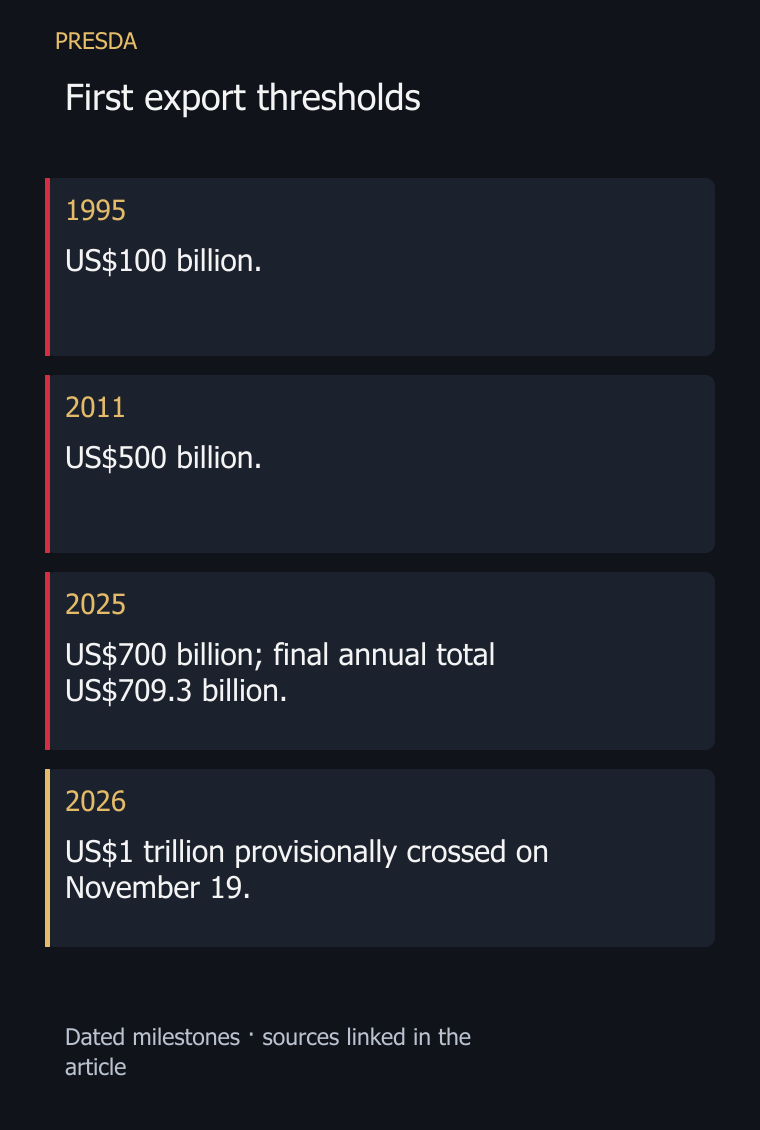
Selected first annual export thresholds from MOTIR’s November 19 historical table. Figures are nominal US dollars; the 2026 crossing is provisional and is not a trade-surplus figure.
Semiconductors and the wider industrial base
The ministry’s October release reported a 259% year-on-year increase in semiconductor exports, compared with 34% growth in non-semiconductor exports. It attributed the broader strength in part to expanding demand for advanced products associated with the AI industry. These are the ministry’s reported figures and explanation, not an estimate of how much every Korean company benefited. MOTIR: October 2026 exports and semiconductor figures
The November milestone statement also emphasised diversification across products, markets and exporters. Its account places the record within an industrial base that includes both established manufacturing and emerging consumer categories. A semiconductor boom can be central to the story without making every other exporting activity disappear from it. MOTIR: November 19 provisional milestone and historical table
PRESDA’s report on Samsung’s AI data-centre expansion provides related context for the connection between chips, computing demand and investment. That corporate story is not a substitute for national customs statistics, but it helps explain why the demand for advanced hardware matters beyond a single product launch.
A strong cycle still carries risks
Concentrated demand can support rapid growth while leaving exporters exposed to changes in orders, prices or technology. A record measured in dollars can also reflect price movements as well as more physical goods shipped. Without a separate price-and-volume decomposition, it would be wrong to describe all the increase as additional production.
The same caution applies to AI. The term covers many products and services, while the ministry’s customs categories measure particular traded goods. A claim about semiconductor exports should not be expanded into a claim that all the revenue comes from AI, or that demand can only move in one direction.
The longer history of an export economy
The ministry’s milestone table records earlier first crossings: US$100 billion in 1995, US$300 billion in 2006, US$500 billion in 2011, US$600 billion in 2018 and US$700 billion in 2025. The final 2025 export total listed there is US$709.3 billion. These historical markers give the new threshold perspective. MOTIR: November 19 provisional milestone and historical table
Its account also traces the transformation from US$100 million in exports in 1964 to US$1 trillion in 2026. The ratio is 10,000 to one across 62 years, a nominal-dollar comparison rather than an inflation-adjusted measure of living standards. It illustrates the scale of change without implying that every citizen’s income increased by the same multiple. MOTIR: explanation of the first trillion-dollar export threshold
For a wider historical perspective, PRESDA’s account of Korea’s earlier kingdoms explores a much older political and cultural landscape. Modern industrial export growth belongs to a different period, and should be understood through its own institutions, firms, workers and international trading relationships.
Why ports and smaller exporters matter
The ministry’s November 17 visit to Incheon New Port placed logistics at the centre of the approaching milestone. The official account identified the port as an important gateway for products from smaller companies, including used cars and cosmetics. That is a useful reminder that export performance depends on more than factories alone. MOTIR: November 17 Incheon New Port visit
Shipping schedules, customs procedures, financing and reliable transport connect production to overseas customers. These systems are less visible than a celebrated consumer brand or a semiconductor plant, but they influence whether an order can actually be delivered. The port visit was an official description of those concerns, not a new nationwide measure of logistics efficiency.
A national record is not a household balance sheet
The benefits of export growth depend on how business activity translates into wages, supplier income, investment and public revenue. A national record does not prove that every region, worker or small enterprise is experiencing the same improvement. Distribution is a separate question requiring separate evidence.
The government’s stated interest in connecting export strength with regional activity and employment should therefore be treated as a policy objective, rather than a result already demonstrated by the trillion-dollar tally. The news is stronger when it reports both the achievement and the limits of the measure.
What the final-year figures will add
The next monthly releases will clarify how the record developed across products and destinations. The eventual annual data will allow fuller comparisons of exports, imports and the trade balance. Readers should check whether any quoted ranking concerns goods alone, includes services or uses a different statistical basis.
As of November 19, the verified milestone is clear: provisional cumulative goods exports have crossed US$1 trillion for the first time. It is a major achievement for South Korea’s export economy. Understanding what it measures makes that achievement more meaningful, without turning it into an unsupported claim about every aspect of national prosperity.
FAQ
Frequently Asked Questions
Did South Korea really reach $1 trillion in exports?
The government’s provisional tally says annual cumulative goods exports crossed the threshold on November 19, 2026.
Is that a monthly total or a trade surplus?
Neither. It is goods exports accumulated since January. Total trade includes imports, while the surplus subtracts imports from exports.
Are these final 2026 figures?
No. The threshold announcement is provisional and precedes the end of the year. Later releases will establish the final annual result.
What drove the surge?
The October ministry release highlights very strong semiconductor growth alongside growth in non-semiconductor exports. The milestone statement also stresses diversification.
Does the record show every household is better off?
No. Export receipts, domestic value added and household income are different measures. Distribution and employment outcomes need their own evidence.
PRESDA Dispatch
Stay Informed. Stay Aware.
A sharp briefing across AI, gaming, sport, business, world affairs, paparazzi, and lifestyle.