TESLA UNVEILS ROCKET-POWERED ROADSTER, TARGETS 2028 PRODUCTION
Tesla’s Texas Roadster reveal: prototype stunts, cold-gas thrusters, claimed acceleration, reservation deposits and the hurdles before planned 2028 production.
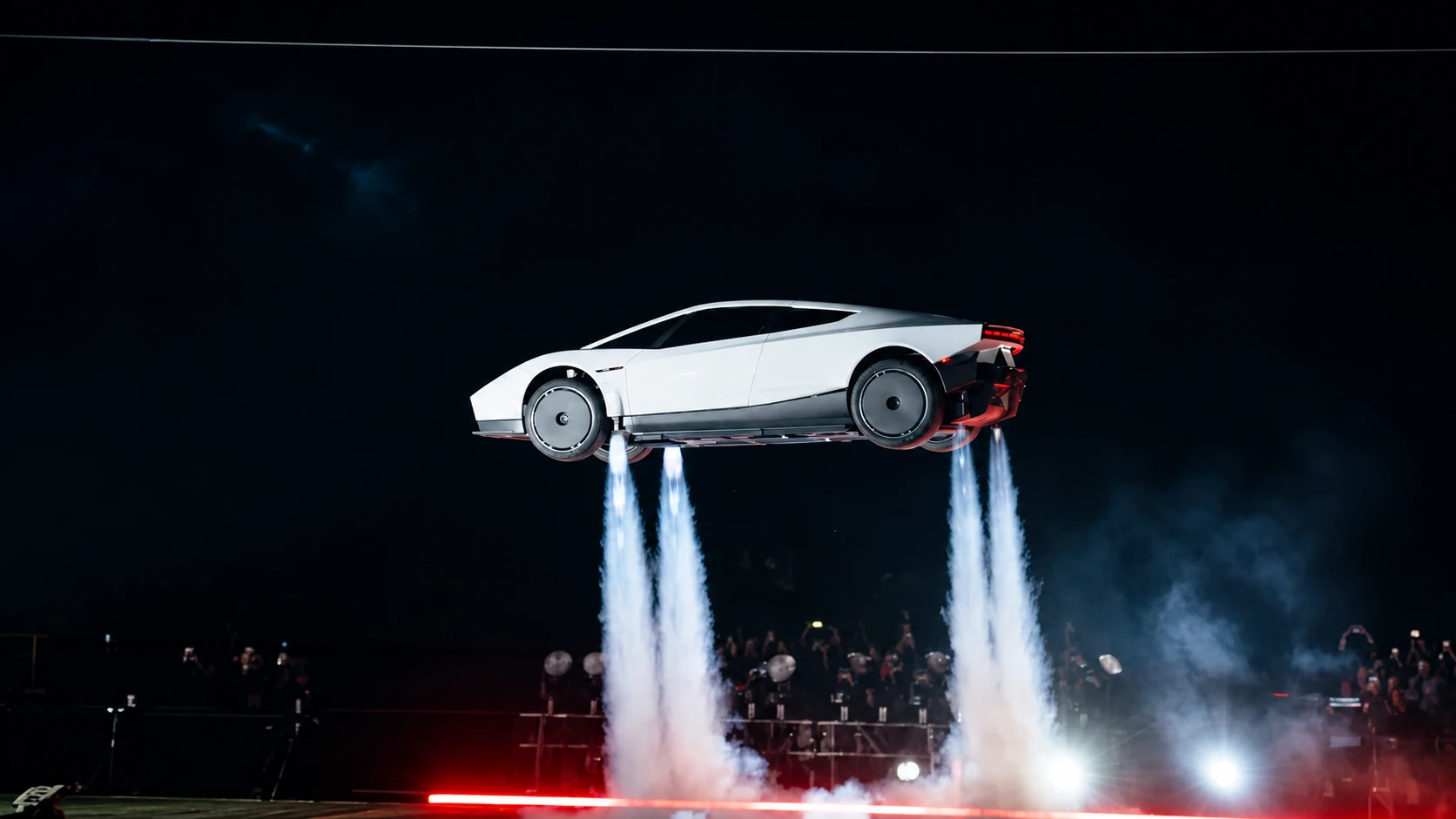
AI-enhanced editorial illustration supplied for PRESDA. This imagined scene is not an authentic photograph of Tesla’s event or evidence of the Roadster’s design or capabilities.
At a rocket-testing site in Texas, Tesla turned its long-delayed sports car into a spectacle of inverted driving and airborne maneuvers. The company unveiled its redesigned Roadster at SpaceX’s McGregor facility on October 15, 2026, and set a production target of 2028. Reuters confirmed the presentation, including a suction-assisted run beneath a curved ramp and a thruster-assisted jump over vehicles. These were prototype demonstrations, not evidence that customers can buy an approved flying car. Reuters: Roadster unveiling
The essential distinction is between what a demonstration shows, what a manufacturer promises and what a finished vehicle can repeatedly deliver. Tesla has supplied an extraordinary first category and ambitious claims in the second. Production specifications, purchase prices and the practical operating limits of the most dramatic features remain questions for the third.
What the Texas demonstration established
Tesla’s official event video presents a white, angular sports car climbing an inverted ramp, leaving its surface and rotating in the air. A later sequence shows another airborne maneuver. The presentation attributes the performance to collaboration between Tesla and SpaceX engineers, with suction providing adhesion and compressed-air thrusters supplying force. The footage is primary evidence of the company’s staged demonstration, not an independent certification of the system. Tesla: official Roadster event
AP reported that the demonstration used autonomous operation rather than a human stunt driver, while the intended car would be manually driven. That difference matters: a controlled, unoccupied stunt does not establish the tolerances, protections or operating permissions needed for an ordinary customer. AP also highlighted regulatory obstacles. AP: demonstration and regulatory questions
Calling these maneuvers sustained flight would go beyond the evidence. A jump, a controlled rotation and a landing do not demonstrate useful airborne range, endurance or routine aerial navigation. The distinction is more than vocabulary. Each additional second aloft requires support against gravity, control authority and a safe response to failures.
Rocket-style propulsion without rocket combustion
Cold-gas propulsion works by releasing stored, pressurized gas through a nozzle. The escaping gas carries momentum in one direction, producing force in the other. NASA describes cold-gas systems as established spacecraft technology, valued for simplicity but constrained by performance and stored propellant. “Rocket-powered” in this context should not conjure a combustion engine burning the propellants of a launch vehicle. NASA: propulsion technology
In a car, thrust can temporarily add a force that does not depend on the driven tires gripping the road. Nozzles arranged in different directions can also produce turning moments. This explains the engineering attraction. It also exposes the trade-off: a pressure vessel contains a finite supply, and replenishing it requires equipment, energy and time. The relevant customer question is therefore not just how forcefully the system works once, but how frequently and under what conditions it can work again.
Suction tackles another problem. Lowering pressure beneath a vehicle allows higher surrounding pressure to push it toward the surface. That is conceptually different from a wing whose downforce depends on airflow as the car moves. This physical principle explains the mechanism; it does not validate Tesla’s implementation. An inverted ramp demands sufficient adhesion throughout the maneuver, while a road vehicle must also cope with changing surfaces, gaps, debris and transitions.
Under one second: a claim that needs a test protocol
Tesla says the redesigned Roadster can reach 60 mph in less than a second and exceed 230 mph. Its presentation also describes a two-seat layout, steer-by-wire and aerodynamic features. These are manufacturer claims and prototype descriptions, not independently verified production specifications. Tesla: official Roadster event
Acceleration comparisons require more than a stopwatch graphic. Was the run measured from a true standstill? Was an initial distance excluded through a rollout convention? What were the surface, tires, charge level and thruster settings? Could the result be repeated with a customer vehicle? Until a comparable protocol and repeatable results are available, the responsible description is a claimed sub-second time, not a settled world record.
Sixty miles per hour is approximately 96.6 km/h, not exactly 100 km/h. Combining those different benchmarks can distort a comparison even before rollout and surface conditions enter the picture. Peak acceleration, maximum speed and circuit performance also measure different abilities; winning one does not automatically settle the others.
Deposits are not purchase prices
Reuters reported reservation deposits of $50,000 for Performance and $250,000 for Thrust, with an invitation-only Rocket configuration. Tesla did not announce final purchase prices at the event. The frequently repeated $200,000 figure belongs to an earlier Roadster proposal and should not be recycled as a verified price for the redesigned car. Reuters: Roadster unveiling
Tesla’s current product page contains configuration qualifications: some advertised features depend on an optional Thrust upgrade, while Rocket availability varies by region. Readers should distinguish a deposit, a trim-specific capability and a completed sale. An impressive presentation does not answer questions about insurance, servicing, replacement parts, warranties or the total ownership cost. Tesla: Roadster product page
Why 2028 remains a target
The next-generation Roadster was first shown in 2017. A 2028 production start would therefore arrive more than a decade after that unveiling, following repeated delays. A target is a statement of intent, not evidence that manufacturing and customer deliveries have been secured. Reuters: Roadster unveiling
For a business reader, the next milestones are less theatrical: a stable production design, supplier commitments, documented validation, manufacturing capacity and delivery terms. A prototype can prioritize an exceptional moment. A commercial vehicle must reproduce its promised behavior across years of use and maintenance. That gap is where the Roadster’s business story now sits.
Road legality is a separate engineering challenge
In the United States, manufacturers self-certify compliance with applicable Federal Motor Vehicle Safety Standards. NHTSA explains that the system is not blanket government pre-approval of every new model. Compliance obligations and enforcement remain real. Nor would compliance alone make an airborne stunt permissible on a public road; operating rules and the relevant jurisdiction would still matter. NHTSA: certification explained
The engineering questions include pressure-vessel protection in a collision, safe handling of gas discharge, landing loads, system faults and the behavior of the vehicle when suction is interrupted. These are questions for validation, not claims that Tesla’s design has failed. Public demonstrations provide too little information to judge their resolution. Evidence should include predictable degraded operation and protection for people outside the car as well as its occupants.
Rimac, Porsche and BYD set different benchmarks
The Roadster is entering an electric-performance field with established rivals. Rimac’s Nevera R emphasizes acceleration and handling, while Porsche’s Taycan Turbo GT combines power with a circuit-focused engineering package. Porsche quotes 0–100 km/h in 2.2 seconds for the Weissach-equipped model, a different benchmark from Tesla’s 0–60 mph claim. Manufacturer figures require their own conditions and cannot be ranked fairly by stripping those conditions away. Rimac: Nevera R Porsche: Taycan Turbo GT
BYD reported that its Yangwang U9 Xtreme reached 496.22 km/h at Germany’s ATP Papenburg track on September 14, 2025. That is a manufacturer-reported top-speed achievement, not the same test as acceleration or an aerial maneuver. PRESDA’s analysis of BYD and Tesla’s electric-car sales competition explores the much larger market beyond such showcase machines. BYD: U9 Xtreme speed run
Could this change ordinary cars?
Some ideas may prove more transferable than others. Better control of aerodynamic forces, improved vehicle sensing and tighter integration between mechanical systems and software have potential value beyond a rare sports car. Whether compressed-air thrusters offer enough everyday benefit to justify their weight, complexity and operating constraints is a separate question. A spectacular use case cannot answer it by itself.
The unveiling has given the Roadster a new identity and a renewed deadline. It has not removed the distance between experiment and product. The decisive achievement will come when the technology is independently measured, its limits are documented and customers receive a vehicle that performs safely and consistently. Until then, the most revealing image is not simply a car above the ground, but the unfinished engineering and commercial journey beneath it.
FAQ
Frequently Asked Questions
What is this PRESDA article about?
Tesla’s Texas Roadster reveal: prototype stunts, cold-gas thrusters, claimed acceleration, reservation deposits and the hurdles before planned 2028 production.
Which category does this story belong to?
This story is part of PRESDA's Business coverage.
Who published this article?
TESLA UNVEILS ROCKET-POWERED ROADSTER, TARGETS 2028 PRODUCTION was published by PRESDA Editorial on PRESDA.
PRESDA Dispatch
Stay Informed. Stay Aware.
A sharp briefing across AI, gaming, sport, business, world affairs, paparazzi, and lifestyle.