Genetic study describes two new Amazonian howler monkey species
Genome-wide comparisons and museum specimens helped researchers identify Alouatta iroi and Alouatta matogrossensis as distinct species.
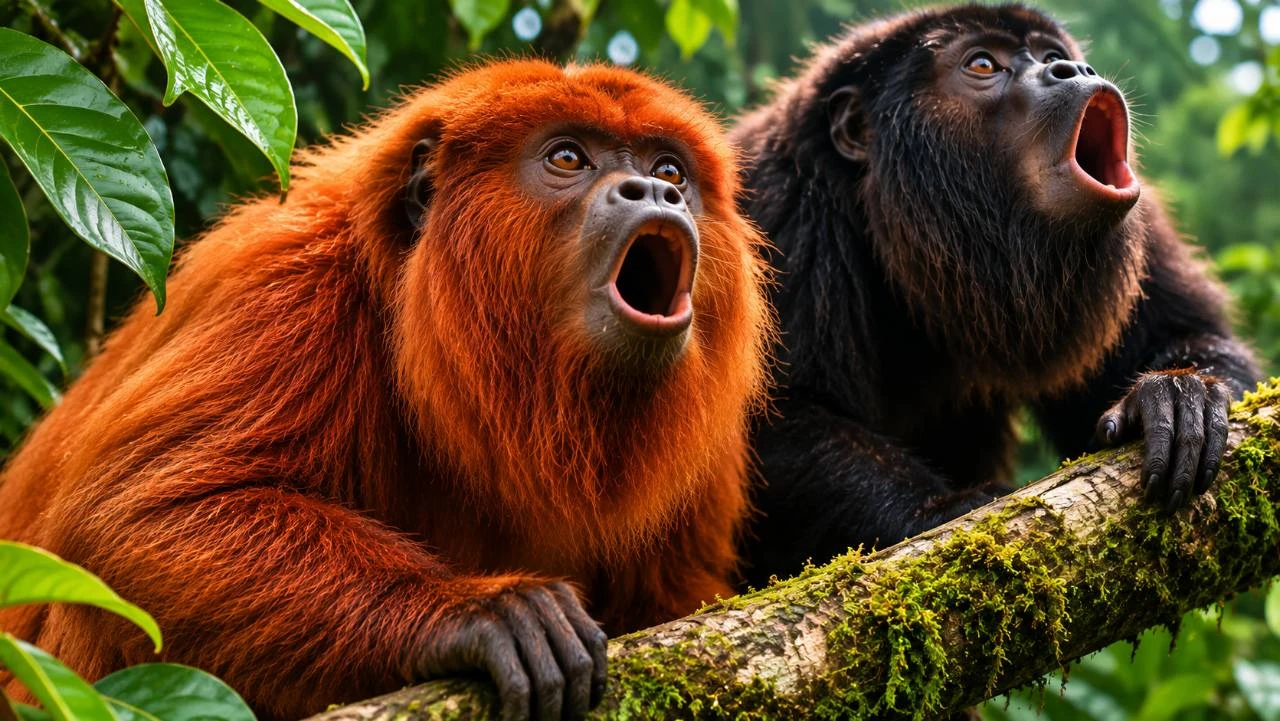
AI-generated editorial illustration supplied for PRESDA.
A study in Communications Biology formally describes two red howler monkeys, Alouatta iroi and Alouatta matogrossensis. The researchers combined genome-wide evidence with the physical features of museum specimens. The names recognise two evolutionary lineages within a familiar group of primates, including specimens collected years before the study. Communications Biology
How the researchers distinguished the species
The team compared genomes across 11 howler species and examined museum specimens for traits that could distinguish lineages. The paper describes differences in fur and in the hyoid, a bone involved in vocalisation. The illustrations accompanying this article are artistic. The formal diagnoses rely on the specimen comparisons and genetic evidence. University of Salford
Where the two howlers live
The Pantepui red howler, Alouatta iroi, is described from northwestern Amazonia. The paper places the Rio Branco along its eastern boundary and leaves its northern limit uncertain. The Mato Grosso red howler, Alouatta matogrossensis, lives in the southern Brazilian Amazon, with a mapped range between the Madeira and Teles Pires rivers. Rivers can help separate populations over evolutionary time, although each range needs its own evidence. Communications Biology
Why conservation assessments matter
Forest conversion and fragmentation threaten habitat in the southern range. The authors call for an urgent assessment of the Mato Grosso red howler and suggest it could qualify as Critically Endangered. That is their assessment of the risk, pending a formal evaluation. They also identify infrastructure and future climate change as concerns in the region of the Pantepui red howler. Communications Biology
A newly recognised species can have a much smaller range than the group in which it was previously included. That makes local forest loss more important to its survival and gives conservation teams a clearer unit to assess. Mongabay
Related coverage
What a genome and a museum specimen reveal together
The researchers compared genomic data spanning 11 howler species across Central and South America and examined physical traits recorded in museum specimens. One line of evidence can distinguish populations in an evolutionary tree. The other lets taxonomists ask which features can be observed and compared in specimens. With sampled locations as well, the team could revisit where established names had concealed distinct lineages. Source · salford.ac.uk
Why the map matters to conservation
Salford’s researchers highlighted major rivers, including the Xingu and Rio Branco, as barriers that helped separate populations over evolutionary time. A range mapped for an older, more inclusive species designation may cover forest that the newly named population does not inhabit. Conservation assessments need to consider the smaller lineage’s own distribution and the pressures within it. For the southern Amazon lineage, the researchers highlighted loss and fragmentation of habitat. Source · salford.ac.uk How scientists compare DNA across species.
What changes when a widespread species is split?
A single name can hide several populations with distinct evolutionary histories. After a split, a range map and population estimate made for the old grouping cannot simply be assigned to each new species. A loss of forest that looked small on a map of the combined range could take up a much larger fraction of the habitat of one lineage. Assessors need fresh occurrence records and a separate evaluation for each recognised species. Source · Communications Biology Source · University of Salford
How to read the boundaries on a howler map
A river can reduce contact without serving as an absolute boundary for every population. Researchers compare the bank and collection locality of each specimen with the lineages inferred from the genomes. Areas with few samples remain harder to interpret. This is where old collections matter: a reliably labelled museum specimen can add a data point even when contemporary surveys have gaps. Source · Communications Biology Source · University of Salford
| Evidence | Use |
|---|---|
| Genomes | Identify and compare evolutionary lineages |
| Museum localities | Connect sampled animals to known places |
| Forest and population surveys | Supply data for separate conservation assessments |
For the distinction between genetic comparisons and species relationships, see how scientists compare human DNA with other species.
FAQ
Frequently Asked Questions
What are the two new species?
Alouatta iroi and Alouatta matogrossensis.
What evidence supports the classification?
The authors combined genome-wide data with diagnostic features of museum specimens.
PRESDA Dispatch
Stay Informed. Stay Aware.
A sharp briefing across AI, gaming, sport, business, world affairs, paparazzi, and lifestyle.