UP HELLY AA: SCOTLAND'S SPECTACULAR VIKING FIRE FESTIVAL
How Lerwick’s Up Helly Aa grew from a Victorian winter celebration, what guizers do and why the festival continues after the galley burns.
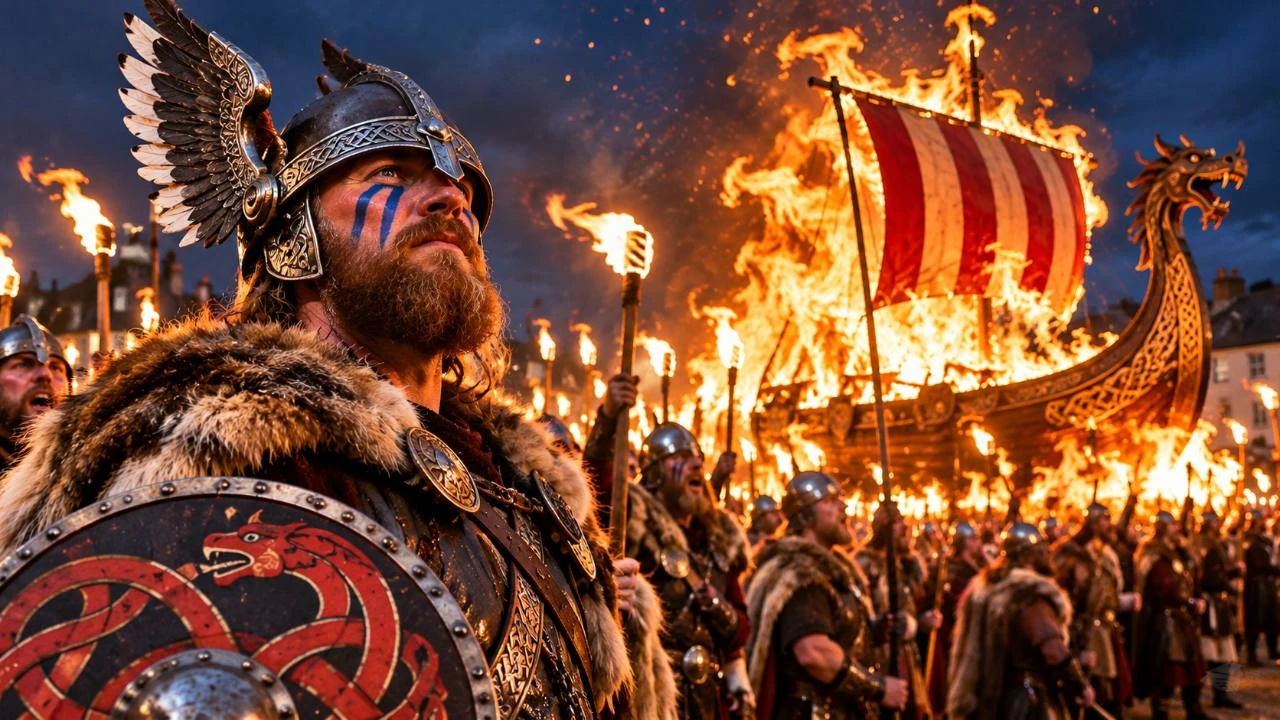
Editorial illustration supplied for PRESDA.
A torchlit procession in Lerwick ends with a replica galley burning. That image is the best-known part of Up Helly Aa, a winter festival in Shetland, Scotland. The day itself starts earlier, with rounds of visits and public appearances. It also goes on after the flames. Squads move through halls where they perform and are received by hosts. The organiser’s account makes clear why the galley is only one part of a celebration that takes repeated work, coordination and rehearsal. Lerwick Up Helly Aa Committee Lerwick committee’s guide to the festival day Shetland events guide
When and where Lerwick holds Up Helly Aa
| Part of the event | What to look for |
|---|---|
| Daytime visits | The Jarl Squad appears around town, with the Bill at the Market Cross |
| Junior procession | Young participants have their own procession and smaller galley |
| Evening spectacle | Torches and the burning of the replica galley |
| Halls | Squad performances and hospitality continue after the fire |
The Lerwick committee schedules its festival for the last Tuesday in January. The Shetland events guide lists the next edition for January 26, 2027. There are separate fire festivals elsewhere in Shetland, with their own organisers and arrangements. A date or route for Lerwick should therefore not be used for another community’s event. Even in Lerwick, the day’s exact access details come from the current programme and local instructions. A date establishes when the festival is held. It does not tell a visitor where to stand or which indoor events welcome the public. Lerwick Up Helly Aa Committee Shetland events guide
Why the Viking theme has a more recent history
Shetland’s Norse connections help explain why Viking images have a place in the festivities. The committee’s history traces the recognisable Lerwick event to developments in the nineteenth century. Earlier winter revelry included tar-barrel celebrations. A newer form took shape in the late 1800s. A replica Viking galley appeared in the late 1880s, and the figure of the Guizer Jarl arrived in 1906. These markers describe a festival gradually developing its own institutions. Calling it Viking-inspired identifies the theme without dating the whole tradition to the Viking Age. Lerwick committee’s history of Up Helly Aa
Who does what on festival day
A guizer is a participant in costume, and participants organise into squads. The Guizer Jarl leads the Jarl Squad, which takes a prominent role in public appearances and the procession. The organisers describe a busy daytime schedule that includes marches and visits. A satirical proclamation called the Bill can be read at the Market Cross. Its place in the schedule shows that the festival has a spoken and written life alongside the costumes and the spectacle. The day brings different groups into town at different hours. Lerwick Up Helly Aa Committee Lerwick committee’s guide to the festival day
The junior event has its own procession
The committee also describes a junior procession and a smaller galley. The junior Guizer Jarl and squad have their own part in the day, and the senior Jarl group can be present to watch and support them. Distinguishing the two events helps make sense of photographs and programmes that refer to different routes or times. It also shows how younger participants can learn what preparation and collective performance involve. Watching a large boat burn is one part of the experience. Putting on a costume or preparing a visit gives a participant a different understanding of what it takes. Lerwick committee’s guide to the festival day
How the parade becomes a fire spectacle
The torchlit procession and burning of the galley are the dramatic peak of the public evening. The galley is built for the occasion. Musicians, participants, organisers and people managing the streets contribute to an event that has to unfold in coordinated steps. Descriptions of the event often use the word longship because of the visual reference to Viking craft. It helps to call it a replica festival galley when explaining what is burned. That wording distinguishes the object from an archaeological vessel and the event from a reconstruction of a documented ancient ceremony. Lerwick Up Helly Aa Committee Lerwick committee’s history of Up Helly Aa Lerwick committee’s guide to the festival day
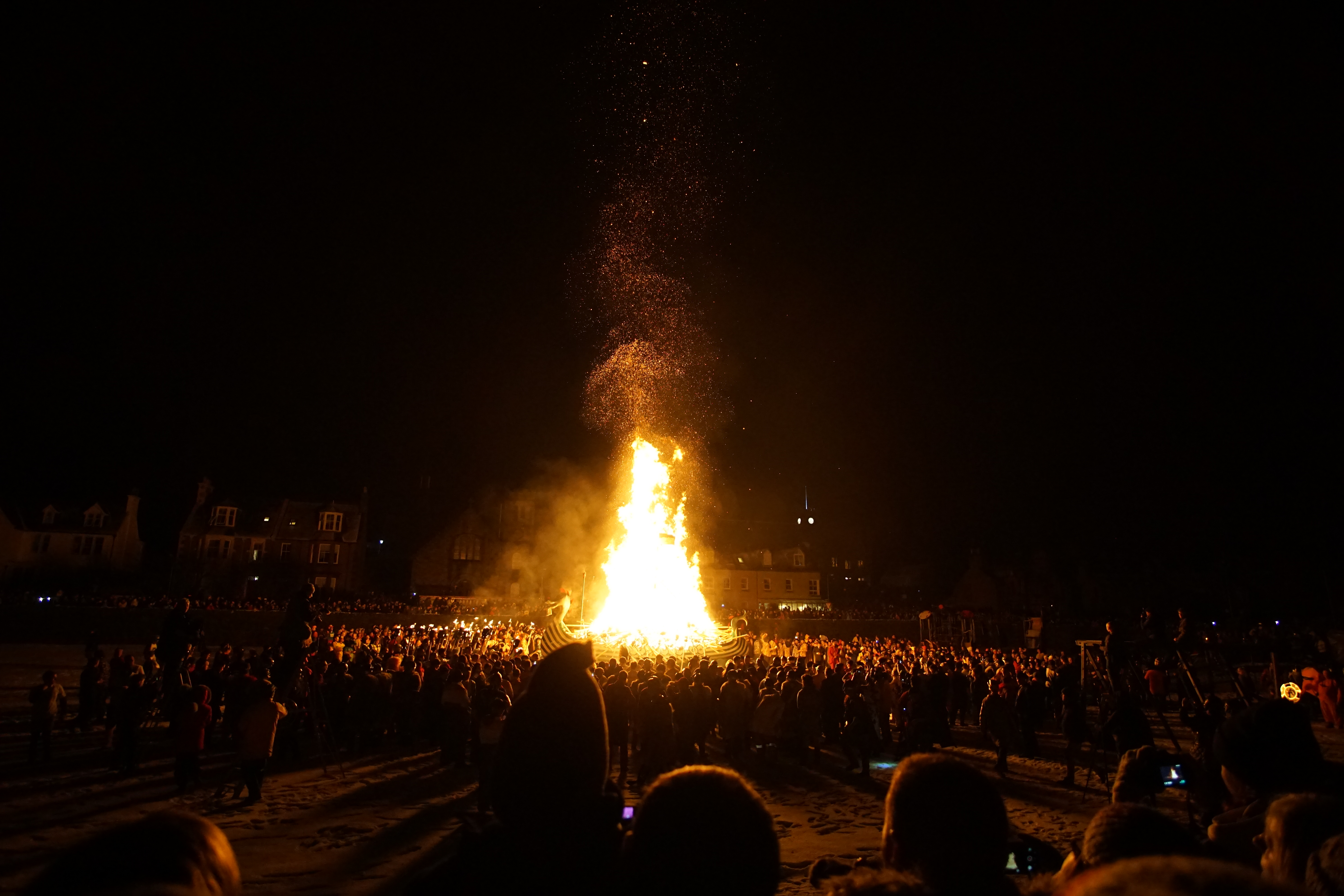
The replica galley burns during Lerwick’s Up Helly Aa in January 2019, seen from King Harald Street.
Why the halls matter
After the burning, squads move among halls. The organisers’ history contrasts private houses opening their doors in the nineteenth century with larger halls staffed by people working together in the modern festival. Squads may prepare performances for the visits. An observer who sees only the procession may miss this part of the occasion. A community’s effort is visible in what it builds outside, but also in food, hospitality, scheduling and the people who keep indoor events running late into the night. Lerwick committee’s history of Up Helly Aa Lerwick committee’s guide to the festival day Shetland events guide
What has changed in who can participate
For the 2023 event, the Lerwick committee lifted its long-standing gender restrictions on squad participation. Its account connects the decision to discussions after the festival’s pandemic interruption. The change affects who can join the festival’s squads. It follows a history in which the people organising halls and other work were already important to the event. In describing the shift it is useful to distinguish a rule for participation in Lerwick’s squads from rules at separately organised Shetland festivals. Lerwick committee’s history of Up Helly Aa
What tradition looks like from one year to the next
A festival can retain recognisable objects and titles while changing its schedule, venues or eligibility rules. The organiser’s record identifies when the galley appeared and when the festival acquired a Jarl. Those dates make it possible to see familiar features as choices made at different moments. The surviving costumes, photographs and galley exhibits then let readers follow changes in design. The most useful historical claims distinguish what a person sees this year from what a report can establish about the first years. Lerwick Up Helly Aa Committee Lerwick committee’s history of Up Helly Aa
How to understand a festival photograph
A lift of the torch, a costume or the fire can identify a moment. It still helps to know whether the scene shows a daytime appearance, the junior event, the main procession or the burning. A picture can make the festival recognisable to a reader far away. The order of events explains the work that the picture leaves out. For another PRESDA feature about the difference between a public ceremony and the broader tradition around it, read the account of Kukur Tihar in Nepal. Lerwick committee’s guide to the festival day Shetland events guide
What the festival archives reveal
The committee’s archive helps separate the event’s stages of development. A dated photograph can establish which costumes and objects were present in a particular year. A surviving Bill, the public proclamation associated with festival day, preserves names, local jokes and the subjects that mattered to the writers. An account written decades afterward is useful for tracing how people remember the event, but it answers a different question. Read together, these records explain how a winter celebration became one of Shetland’s best-known public traditions. Lerwick Up Helly Aa Committee Lerwick committee’s history of Up Helly Aa
The handover from the procession to the halls also changes the audience. The crowd in the street sees a shared route and a single ending at the burning site. Indoors, squads visit multiple venues and perform the material prepared for that year. Each hall sees only one part of the schedule at a time. Following the public itinerary therefore gives you a different sense of the event than following one squad from its preparations to its last performance. Lerwick committee’s guide to the festival day Shetland events guide
FAQ
Frequently Asked Questions
When is Lerwick Up Helly Aa?
It is held on the last Tuesday in January. The 2027 event is listed for January 26.
Is Up Helly Aa an ancient Viking festival?
The Lerwick festival developed its modern form in the nineteenth century using Viking themes.
What happens after the galley burns?
Squads visit halls where hosts receive them and performances continue.
PRESDA Dispatch
Stay Informed. Stay Aware.
A sharp briefing across AI, gaming, sport, business, world affairs, paparazzi, and lifestyle.