ZANZIBAR'S SLAVE MARKET: WHEN HUMAN BEINGS WERE SOLD
Understand Zanzibar’s slave market, the clove plantation economy, the difference between 1873 and 1897 and the history remembered at Christ Church.
Editorial illustration supplied for PRESDA.
Zanzibar’s former slave market, in Stone Town on the island of Unguja, stands within a much larger history of forced movement, plantation labour and Indian Ocean commerce. The market closed in 1873, but the legal status of slavery survived until 1897. Holding those dates apart is essential to understanding what abolition changed and what enslaved people still had to confront afterward. UNESCO Stone Town of Zanzibar listing World Monuments Fund cathedral and market exhibition UK National Archives HMS Daphne photographs and context
Where was the market, and what remains?
| Date or period | Milestone | Meaning |
|---|---|---|
| Mid-19th century | Expansion of clove plantations and forced labour | Zanzibar was both a destination and a transit point |
| 1873 | Market closure and prohibition of transport by sea | A restriction on trade, with slavery continuing |
| 1897 | Abolition of slavery’s legal status | A separate milestone from the market’s closure |
| From 2013 | Conservation and interpretation project at Christ Church | Preservation of a site of conscience and its public history |
Christ Church Cathedral occupies the site associated with the former market. World Monuments Fund describes the church and the heritage centre as a place of remembrance, supported by conservation work undertaken with local institutions. Stone Town itself is a UNESCO World Heritage property, recognised for a Swahili urban culture shaped by connections across Africa, Arabia, India and Europe. The market’s history belongs within that wider town, while exposing the coercion behind part of its nineteenth-century commerce. UNESCO Stone Town of Zanzibar listing World Monuments Fund cathedral and market exhibition
A memorial is a later response to an earlier crime
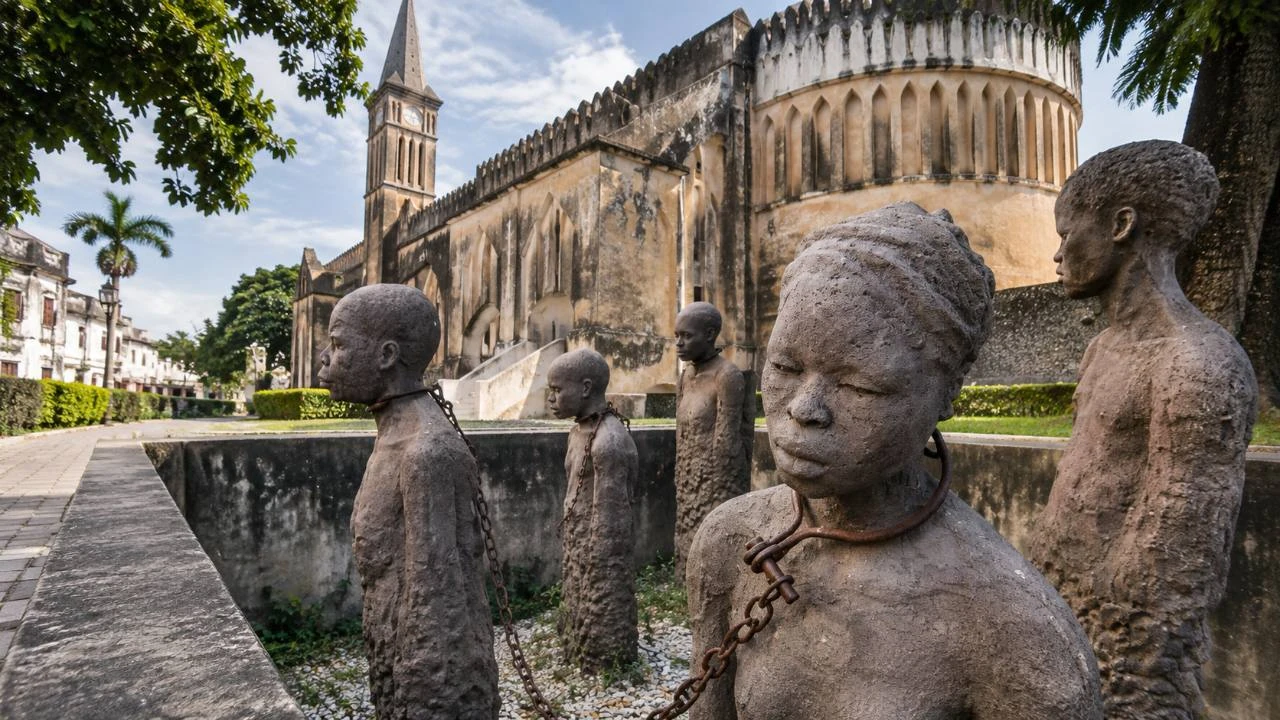
The figures at the site’s memorial represent enslaved people and invite reflection on their treatment. They are a commemorative work. Their appearance does not record the faces of identified people sold at a particular auction. The supplied hero evokes this memorial and is labelled as an illustration. The archival image within the article has its own date and provenance. Keeping these categories visible helps visitors recognise how the place remembers the past and what survives as evidence of it.
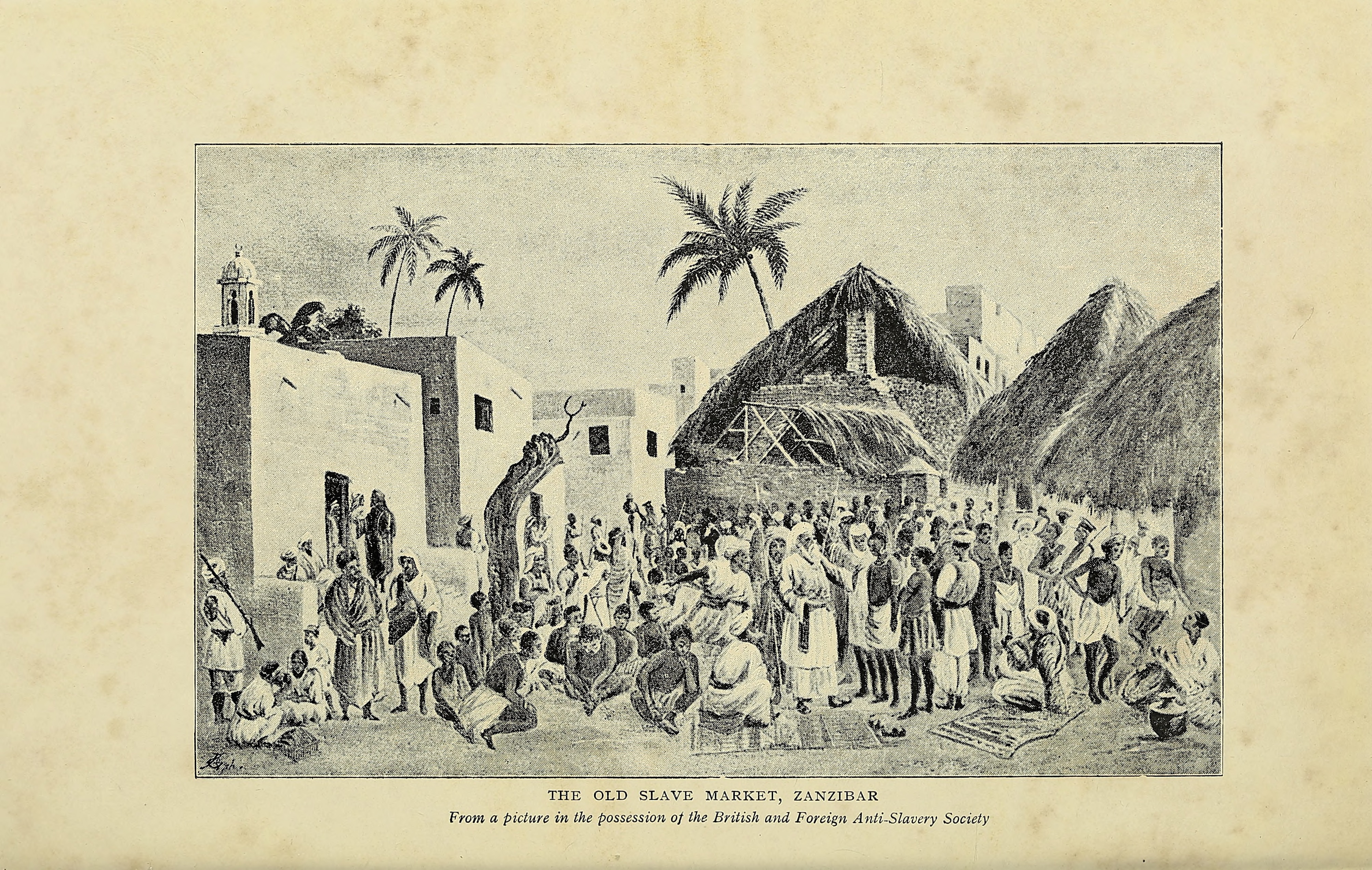
An illustration of the old slave market reproduced in the 1909 history of the Universities’ Mission to Central Africa. This later publication is an archival illustration, not a photograph of an identified sale.
Illustration reproduced in A. E. M. Anderson-Morshead’s 1909 mission history / Wikimedia Commons · Public domain
How Zanzibar became a centre of the trade
The nineteenth-century expansion of the island economy connected trade with the African mainland, maritime routes and the growth of clove plantations on Unguja and Pemba. The historian Abdul Sheriff’s study links enslavement to merchant capital, exports and plantation ownership. The market was one point in that system. Following the movement of money, people and crops makes it possible to understand why coercion persisted even when an open market could be closed. Abdul Sheriff, Slaves, Spices and Ivory in Zanzibar
The plantations are part of the same story
Some enslaved people were transported onward, while others were forced to work on the islands. The UNESCO nomination dossier describes both imports and the absorption of people into clove production. That distinction matters. Zanzibar was a destination for forced labour as well as a point of transit. A history focused only on ships leaving the harbour would miss the work carried out on plantations and in households, and the lives constrained within the archipelago itself. UNESCO Stone Town nomination dossier
Who was involved, and who bore the harm?
The system joined political authority, merchants, landowners, transporters and purchasers across different places. It should be examined through named roles and particular institutions rather than assigning inherited guilt to a modern population or religion. Enslaved people came from diverse communities and endured separation, forced movement and the denial of control over their labour. The categories used in a commercial record reflect how a trader classified people. They do not define the people’s whole identities. Abdul Sheriff, Slaves, Spices and Ivory in Zanzibar Law and History Review study of the sultans’ abolition legislation
Why a route map is only a beginning
A line from the mainland coast to Zanzibar simplifies a chain that could include capture, sale, movement overland, confinement and further transport. Different people experienced different stages. A map helps locate the system but cannot show all of its violence or every attempt to escape it. Read alongside a dated record, it can answer where an official or merchant observed a journey. It cannot by itself establish the starting place, language or later life of every person moved along that route.
What can archival images tell us?
The UK National Archives presents photographs of people taken from a dhow by HMS Daphne in 1868. The photographs belong to a naval report and are evidence from an Indian Ocean anti-slaving operation. The archive explicitly asks readers to consider what is known about their circumstances. They should not be relabelled as photographs of Zanzibar’s auction site or used to illustrate an Atlantic crossing. Location, date, photographer and the purpose of the record are part of their meaning. UK National Archives HMS Daphne photographs and context
What a photograph leaves outside the frame
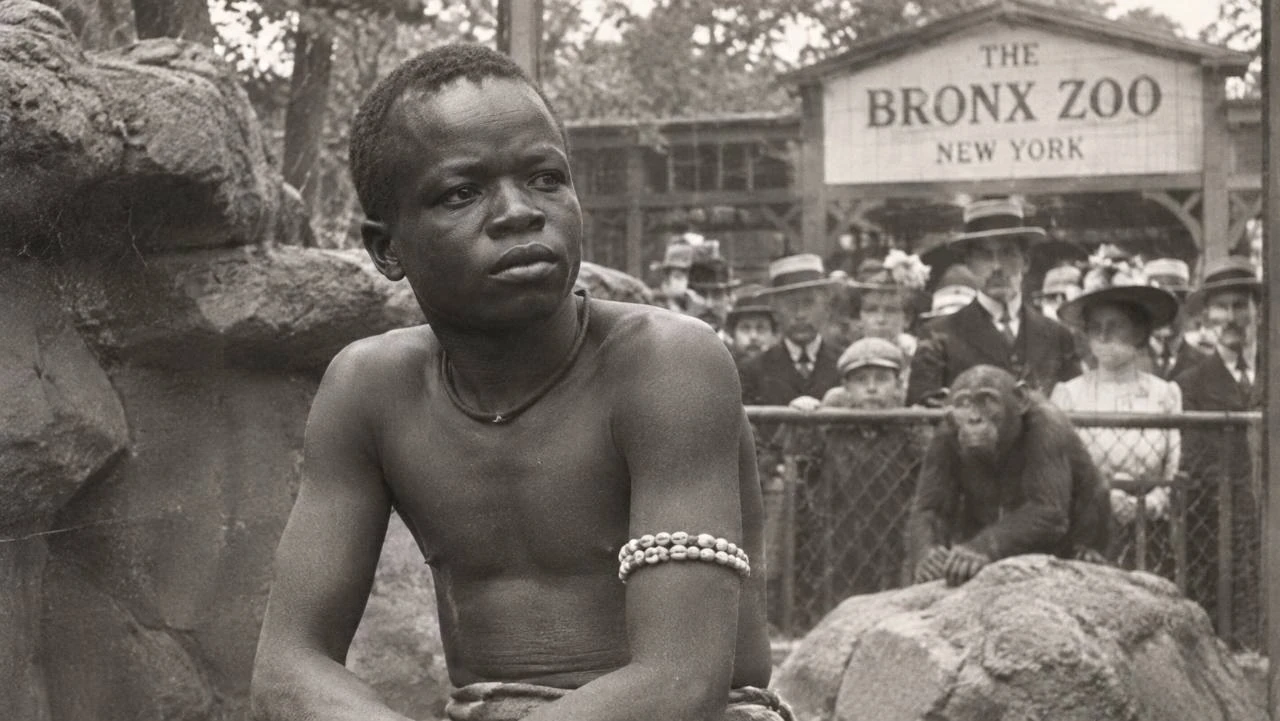
A photograph can show people present at one moment, their surroundings and the way they were arranged before a camera. Names, prior journeys and subsequent experiences may require other records, if they survive. Captions written by officials can describe the people through the officials’ interests. Preserving the image’s source while explaining those limits avoids replacing one form of objectification with another. The same care matters in the history of Ota Benga and his exhibition at the Bronx Zoo.
How many people passed through Zanzibar?
The UNESCO nomination dossier offers an estimate of more than 20,000 annual imports by the middle of the nineteenth century. That is a period-specific estimate for a trade and its destinations, rather than an exact count of sales at the present memorial site. Totals can differ because writers count imports, exports, plantation populations or deaths during transport. These measures should retain their dates and definitions. Adding figures from different categories risks counting the same people more than once. UNESCO Stone Town nomination dossier
Why an estimate needs its unit and timescale
“Twenty thousand” could mean people moved in one year, people present at a given date or a sum over several years. Those are different claims. A port register may also omit clandestine movements or people who died before arrival. The purpose of identifying these limits is to preserve the meaning of the evidence. A qualified estimate can show scale while leaving uncertainty explicit. False precision would make the narrative easier to repeat and less accurate.
What changed in 1873?
Under Sultan Barghash bin Said, the 1873 measures prohibited transport of enslaved people by sea and closed the market. British diplomatic and naval pressure formed part of the context. Research in Law and History Review examines this legislation alongside later decrees under other sultans. The 1873 change attacked specific channels of trade, but it did not immediately abolish every existing legal relationship of enslavement or free everyone on the plantations. World Monuments Fund cathedral and market exhibition Law and History Review study of the sultans’ abolition legislation
The years between the market’s closure and abolition
A person could remain subject to a claim of ownership after the public market closed. That is why a chronology needs to follow law beyond the dramatic moment of closure. Rules on transfers, inheritance, jurisdiction and the ability to make a claim could affect whether a person could act on a change in policy. The historical question becomes how people obtained freedom in practice, as well as when a ruler announced a prohibition. Law changed through successive measures, with consequences that had to be tested and enforced. Law and History Review study of the sultans’ abolition legislation
Why 1897 is another essential date
The legal status of slavery was abolished in Zanzibar in 1897 under Sultan Hamoud bin Mohammed. The National Archives and the legal scholarship distinguish this from the earlier restriction on trade. Even then, a decree and the practical means to leave coercive labour were separate matters. Access to land, wages, family support and a place to live shaped what a newly free person could do. Emancipation therefore had a social and economic history beyond its legal date. UK National Archives HMS Daphne photographs and context Law and History Review study of the sultans’ abolition legislation
Agency and freedom after a decree
People who had been enslaved were participants in that change. Their efforts to obtain support, establish households and improve their working conditions belong in the story, even where the archive preserves officials’ decisions more readily than individual voices. A history organised solely around foreign abolitionists would give the people most affected too little space. British anti-slaving action also needs to be read alongside imperial interests and Britain’s earlier involvement in slavery.
Why the cathedral and conservation matter
World Monuments Fund’s account identifies the cathedral as a central marker of what happened at the site. In 2013, the Anglican Diocese and Zanzibar’s government sought help with conservation and interpretation. Repairing the building created an opportunity to explain the market’s history through a heritage centre. Preserving a site of conscience involves both maintaining its fabric and making its history intelligible. The exhibition’s labels and source choices influence what visitors understand about trade, slavery and abolition. World Monuments Fund cathedral and market exhibition
Reading religious architecture in its local setting
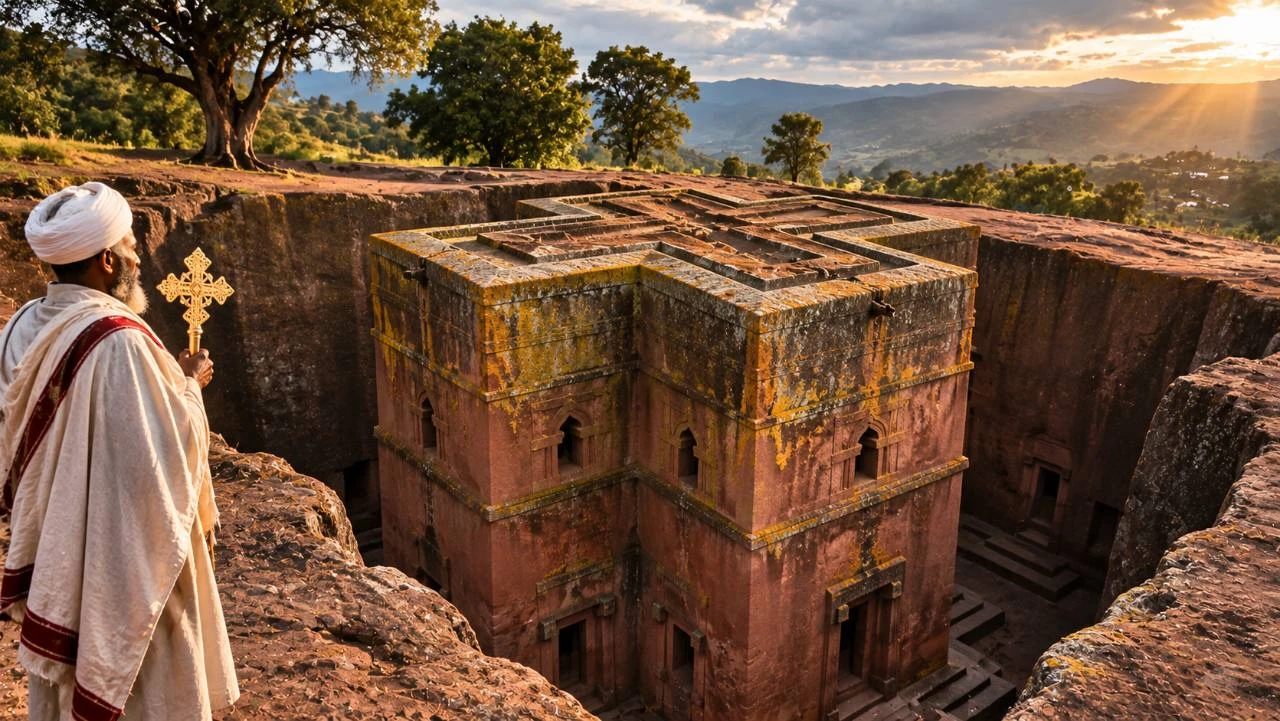
The church is part of Stone Town’s architectural landscape, alongside mosques, houses and commercial streets. UNESCO’s description places those structures within a shared urban history. A visitor can therefore consider the cathedral as a building, a place of worship and a later act of remembrance at the same time. PRESDA’s account of Lalibela’s rock-hewn churches offers another example of religious architecture whose meaning also depends on continuing use and the historical landscape around it. UNESCO Stone Town of Zanzibar listing
How to approach the site respectfully
The most useful questions concern what happened, how it is documented and whose voices the display preserves. Ask whether an object is original, reconstructed or commemorative, and whether a number describes one year or a longer period. An illustration can help introduce a complex setting, but a caption should identify its status. Reading the site in this way keeps attention on the people whose lives were constrained by the system, the choices that sustained it and the work required to dismantle it.
FAQ
Frequently Asked Questions
Where was Zanzibar’s slave market?
At the site associated with Christ Church Cathedral in Stone Town on Unguja, in today’s Tanzania.
Did slavery end in Zanzibar in 1873?
The market closed and maritime transport was prohibited in 1873. Slavery’s legal status was abolished in 1897.
Were all enslaved people transported onward?
No. Many were forced to work on the islands, notably in the clove plantation economy, while others were transported elsewhere.
How should historical totals be interpreted?
Keep the date, location and measure attached. Imports, exports, plantation populations and sales at a specific site are different quantities.
Are the memorial figures archival evidence?
They are a later commemorative work. Archival photographs and documents require their own dates, sources and careful captions.
PRESDA Dispatch
Stay Informed. Stay Aware.
A sharp briefing across AI, gaming, sport, business, world affairs, paparazzi, and lifestyle.