TITANIC: WHAT REALLY HAPPENED THAT NIGHT?
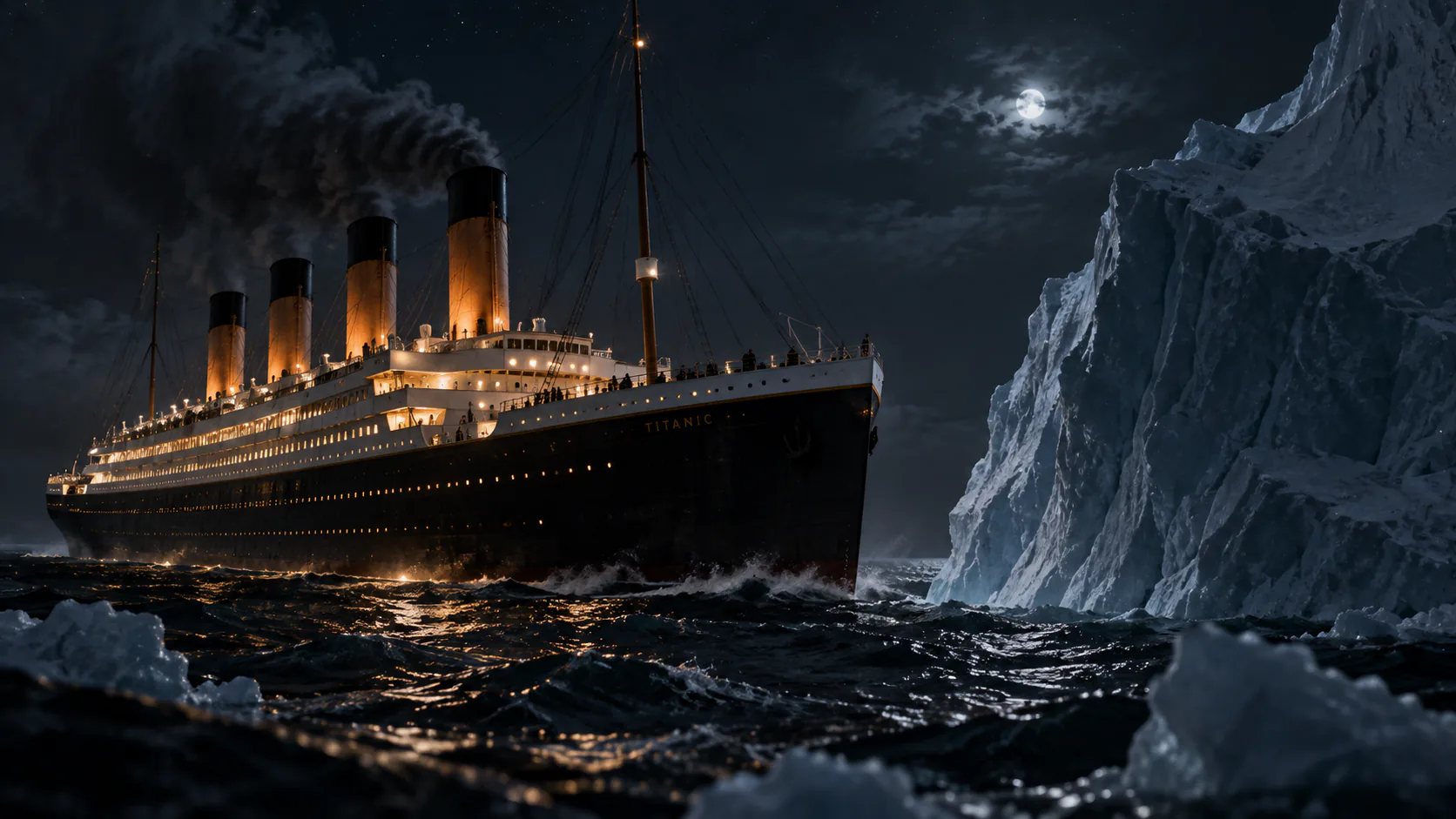
On April 14, 1912, RMS Titanic struck an iceberg in the North Atlantic. Less than three hours later, the liner was gone, leaving more than 1,500 people dead and a disaster that still demands careful history.
Titanic is often remembered as a symbol before it is understood as a real ship.
The name has become shorthand for luxury, arrogance, tragedy, ice, music, lifeboats and the dangerous belief that technology can outrun nature.
But the real Titanic disaster was not a single dramatic moment.
It was a chain of decisions, engineering limits, weather conditions, class divisions, communication failures, emergency procedures and human courage under impossible pressure.
On April 14, 1912, RMS Titanic struck an iceberg at about 11:40 PM ship's time. On April 15, at about 2:20 AM, the ship sank beneath the North Atlantic.
More than 1,500 people died. About 700 survived.
Those numbers are not movie scenery. They represent passengers, crew members, families, emigrants, millionaires, stewards, engineers, wireless operators, sailors, children and people whose names were sometimes recorded imperfectly or not remembered widely at all.
This is what the historical record, official inquiries and modern wreck research show about what really happened that night.
For more PRESDA history context, read Ancient Greece, the history of slavery and the Egyptian pyramids.
Building Titanic
RMS Titanic was built in Belfast by Harland and Wolff for the White Star Line.
She was one of the Olympic-class liners, designed for the high-profile North Atlantic passenger route connecting Europe and North America.
Titanic was extraordinary because of her size, luxury, subdivision and public reputation. She was not marketed with the exact modern phrase 'unsinkable' as if no one believed physics applied to her, but press and promotional language around ships of her class emphasized safety and advanced design.
The ship had watertight compartments and doors that could be closed to slow flooding. The system was impressive for its time, but it had a critical limit: the watertight bulkheads did not extend high enough to contain flooding if too many forward compartments were opened to the sea.
Titanic was a technological achievement.
She was also vulnerable.
That combination is central to the disaster.
Why Titanic Seemed Extraordinary
Titanic measured more than 880 feet in length and represented the scale and ambition of early 20th-century ocean travel.
For first-class passengers, the ship offered dining rooms, lounges, suites, promenades, electric lighting and a level of comfort meant to compete with the finest hotels.
For many second- and third-class passengers, Titanic was not simply a luxury object. It was transportation, work, migration and hope. Third-class passengers included people crossing the Atlantic for new lives in the United States and Canada.
The ship carried mail, cargo, crew and passengers across a route that was both routine and dangerous.
The North Atlantic was a highway.
It was also an ocean of fog, cold, storms and ice.
Southampton and the Maiden Voyage
Titanic left Southampton, England, on April 10, 1912.
She then stopped at Cherbourg, France, and Queenstown, Ireland, now Cobh, before heading west across the Atlantic toward New York.
The voyage began with ceremony and attention. Titanic was new, enormous and famous before she completed a single crossing.
Captain Edward J. Smith commanded the ship. He was an experienced White Star captain nearing the end of a long career. Thomas Andrews, managing director of Harland and Wolff's design department, was aboard as part of the guarantee group observing the ship's performance. J. Bruce Ismay, chairman of the White Star Line, also sailed as a first-class passenger.
Their later reputations would become tied permanently to the disaster.
Passengers and Class Divisions
Titanic was a floating class system.
First-class passengers occupied the most luxurious spaces and included some of the wealthiest people in the Atlantic world. Second-class passengers often included professionals, clergy, teachers and travelers who enjoyed comfortable accommodations below the first-class level.
Third-class passengers were more likely to be emigrants, workers and families traveling with fewer resources.
Class shaped where people slept, ate, moved and received information.
It also affected survival.
The evacuation did not unfold as a neat mathematical sorting of class, gender and age. It was chaotic, uneven and shaped by location, language, information, crew decisions, locked or confusing routes, lifeboat access and luck.
But survival rates show that first-class passengers were far more likely to survive than third-class passengers and many crew members.
The Titanic disaster was therefore not only a maritime failure.
It was also a social event exposing inequalities built into the ship itself.
Iceberg Warnings
Titanic received multiple ice warnings during the voyage.
Other ships reported ice and icebergs in the North Atlantic. The wireless operators aboard Titanic handled both navigational messages and heavy passenger traffic, because wireless communication was also a commercial service for sending private messages.
Some ice warnings reached the bridge. Others were delayed, not treated with sufficient urgency or became lost inside the normal flow of shipboard communication.
This does not mean one ignored message alone sank Titanic.
The disaster emerged from accumulation: speed in an ice region, a moonless night, calm water that made waves at the base of ice harder to see, no binoculars in the crow's nest, delayed sighting and a ship that could not survive the extent of hull damage.
Official inquiries later examined these warnings closely because they showed that the danger was known in general, even if the exact iceberg was not.
April 14, 1912
By Sunday, April 14, Titanic was moving west through the North Atlantic.
The day was calm and cold. Ice warnings continued to come in. The sea became unusually still at night.
A flat sea can make ice harder to detect because waves breaking around an iceberg may be less visible.
Lookouts Frederick Fleet and Reginald Lee were in the crow's nest. They did not have binoculars, though whether binoculars would have changed the outcome remains debated.
At about 11:40 PM, Fleet saw an iceberg ahead and rang the warning bell.
The bridge ordered evasive action.
It was too late.
The Collision at 11:40 PM
Titanic did not smash head-on into the iceberg in the most familiar imagined way.
The ship struck a glancing blow along the starboard side.
The collision opened a series of damage points below the waterline across multiple forward compartments.
For passengers, the impact could feel surprisingly mild depending on where they were. Some barely noticed. Others felt a shudder, scraping or change in motion.
That is part of what made the disaster so deadly.
The ship did not immediately look doomed to many people aboard.
Below, water was entering.
Above, much of the ship still appeared lit, solid and calm.
How the Iceberg Damaged the Ship
Modern analysis of the wreck and historical inquiry evidence indicate that the iceberg caused a pattern of openings and structural damage along the starboard side, allowing water into several compartments.
The total damaged area was not necessarily a single gigantic tear. It was more likely a series of ruptures, separations and openings across the hull plating and seams.
Titanic was designed to remain afloat with a limited number of compartments flooded.
But the iceberg damage affected too many forward compartments.
As water filled them, the bow settled lower. Water then spilled over the tops of bulkheads into adjacent compartments, progressively overwhelming the ship.
The danger was not only the initial puncture.
It was the way flooding moved through the ship once the design limit had been exceeded.
Why Titanic Sank
Titanic sank because the iceberg damage allowed the sea to flood more compartments than the ship could survive.
The forward compartments filled first, pulling the bow downward. As the angle increased, water advanced from one compartment to the next.
Thomas Andrews reportedly understood early that the ship was doomed once he assessed the damage. Later accounts of his exact words vary and should be treated carefully, but inquiry evidence and survivor testimony make clear that the damage was recognized as catastrophic.
The ship's great size did not save it.
Its compartment system slowed disaster but could not stop it.
The sinking was therefore not caused by one simple villain: not only speed, not only ice, not only lifeboats, not only design and not only human error.
It was the collision between a vulnerable design envelope and a specific night in the North Atlantic.
Lifeboats and the Evacuation
Titanic carried too few lifeboats for everyone aboard.
That shortage was legal under outdated regulations, but it was disastrous.
The ship carried 20 lifeboats, enough for roughly 1,178 people, fewer than the number aboard. Even that capacity was not fully used because some early boats left partly filled.
Evacuation was slow and confused at first. Many passengers did not understand the danger. Some were reluctant to leave a warm, brightly lit liner for small boats over a black ocean. Crew members also varied in how they interpreted orders such as 'women and children first' or 'women and children only.'
Class location, access routes, language barriers and information gaps shaped who reached the boat deck in time.
The lifeboat failure remains one of the most haunting parts of the Titanic disaster because it shows how regulation can lag behind reality.
Titanic did not need enough boats for a theoretical compliance chart.
It needed enough boats for the people aboard.
Wireless Operators and Distress Calls
Titanic's wireless operators, Jack Phillips and Harold Bride, played a crucial role after the collision.
They sent distress calls using CQD and SOS, contacting nearby ships and relaying the emergency.
The Cunard liner Carpathia received the distress call and turned toward Titanic at high speed under Captain Arthur Rostron.
The Californian was closer, but its wireless operator had gone off duty, and the ship did not respond in time. The role of Californian became one of the most debated questions in the inquiries.
Phillips continued sending messages as the emergency worsened. Bride survived; Phillips died.
Wireless technology did not prevent the disaster.
But it helped bring rescue.
After Titanic, maritime communication rules changed dramatically.
The Final Hour
As the bow sank lower, Titanic's stern rose higher.
People moved toward the aft decks. The angle became steeper. Power eventually failed. The ship broke apart as structural stresses exceeded what the hull could bear.
For decades, some accounts debated whether Titanic broke in two before sinking. The discovery of the wreck in 1985 confirmed that the ship lies in two main sections, bow and stern, separated on the seabed.
At about 2:20 AM on April 15, Titanic disappeared beneath the surface.
Hundreds of people were left in freezing water.
Most did not survive long.
The lifeboats nearby held survivors listening in darkness, many of them traumatized, cold and unsure whether rescue would come.
Carpathia Arrives
Carpathia reached the area after Titanic had sunk.
Its crew rescued survivors from the lifeboats in the early morning hours of April 15.
Captain Rostron and the Carpathia crew were later praised for their response. The ship had moved quickly, prepared blankets, medical help, food and spaces for survivors, and navigated through dangerous ice to reach the scene.
Carpathia carried the survivors to New York.
When the ship arrived, grief and public shock became global news.
The world's most famous liner had not completed her first voyage.
Casualties and Survivors
The exact number of people aboard and the exact casualty figure can vary slightly between sources because passenger lists, crew records and names were corrected after the disaster.
The broad historical consensus is that more than 1,500 people died and about 700 survived.
The U.S. Senate inquiry reported 706 survivors and 1,517 deaths using its accounting. Other authoritative institutions present similar totals with small differences.
Those differences should not be treated as mystery.
They reflect the difficulty of reconstructing records from an international disaster involving passengers, crew, transfers, cancellations, aliases and incomplete documentation.
What matters is clear: most people aboard Titanic died.
Survival was not evenly distributed.
Women and children survived at higher rates than men. First-class passengers generally survived at higher rates than third-class passengers. Many crew members died while trying to keep systems operating, launch boats, send messages or help passengers.
Captain Edward Smith
Captain Edward Smith went down with Titanic.
He had decades of experience and was one of White Star's most senior captains.
Later portrayals have swung between blaming him personally and turning him into a noble symbol. Neither approach is enough.
Smith commanded a ship traveling through an ice-warning region at speed. That decision belongs in the historical assessment. But Titanic also operated within a wider maritime culture where large liners commonly maintained schedules and where the risks of ice were managed with assumptions that failed catastrophically that night.
Smith's exact final actions are uncertain because eyewitness accounts differ.
The responsible conclusion is narrower: he was captain of the ship, he died in the sinking and his command decisions were examined by official inquiries.
Thomas Andrews
Thomas Andrews was closely connected to Titanic's design and construction.
After the collision, he helped assess damage and reportedly urged evacuation. Many survivor accounts remember him as calm, serious and focused on the ship's fate.
Like Smith, Andrews became a figure of legend after his death.
The verified core is powerful enough without invention: the designer was aboard the ship he helped create, recognized the seriousness of the damage and died in the disaster.
The tragedy of Andrews is not that he failed to build a perfect ship.
It is that Titanic's impressive engineering met a damage scenario it could not survive.
J. Bruce Ismay
J. Bruce Ismay survived in a lifeboat and became one of the most criticized figures in the aftermath.
As chairman of the White Star Line, his survival while so many died made him a target of intense public anger.
Historical judgment should separate evidence from scapegoating.
Ismay was aboard. He entered a lifeboat and survived. Inquiries examined his conduct and broader White Star practices. Claims that he directly ordered Captain Smith to recklessly race through ice for publicity are not established as proven fact in the official record.
Ismay's reputation never recovered fully.
But responsible history does not need to invent commands in order to criticize the system he represented.
Official Inquiries
The Titanic disaster led to major investigations on both sides of the Atlantic.
The U.S. Senate inquiry began quickly after survivors reached New York. The British Wreck Commissioner's inquiry followed in the United Kingdom.
The inquiries gathered testimony about ice warnings, speed, lifeboats, wireless communication, ship design, crew training and the conduct of nearby vessels.
They did not answer every question perfectly. They reflected the assumptions and politics of their time.
But they remain essential historical records because they preserved eyewitness testimony close to the event.
They also made clear that maritime safety rules had failed to keep pace with the size and complexity of modern liners.
Maritime Safety Reforms
Titanic changed maritime safety.
One of the most important results was the 1914 International Convention for the Safety of Life at Sea, known as SOLAS.
Reforms strengthened lifeboat requirements, emergency drills, wireless watchkeeping and ice patrol practices.
The International Ice Patrol was created to monitor iceberg danger in North Atlantic shipping lanes.
Titanic therefore became more than a tragedy.
It became a legal and regulatory turning point.
The lesson was brutally simple: safety systems must be designed for real emergencies, not merely for minimum compliance.
The Wreck Is Found in 1985
For decades, Titanic rested unseen on the ocean floor.
In 1985, a team led by Robert Ballard of Woods Hole Oceanographic Institution and Jean-Louis Michel of the French research institute IFREMER located the wreck.
The discovery transformed Titanic research.
It confirmed the ship had broken apart and showed the wreck lying in two main sections more than two miles below the surface of the North Atlantic.
The site was not a preserved museum gallery.
It was a deep-sea debris field, a grave site and an archaeological record of a violent sinking.
Modern Titanic history changed because researchers could finally compare testimony, inquiry conclusions and physical evidence on the seabed.
What Modern Expeditions Revealed
Modern expeditions documented the bow, stern, debris field, boilers, hull openings, personal objects, machinery and corrosion.
They showed that the bow section remained comparatively recognizable while the stern was far more damaged, consistent with a more violent descent and breakup.
Scientific and archaeological work also revealed the wreck's ongoing deterioration. Iron-eating bacteria, corrosion, currents and human visitation have affected the site.
NOAA and other institutions have emphasized the importance of treating Titanic as a historic wreck and memorial site.
Expeditions can answer technical questions.
They also raise ethical ones.
How should the world study a place where more than 1,500 people died?
Titanic Myths and Verified Evidence
Titanic attracts myths because the story feels almost too symbolic.
One myth says the ship was simply declared unsinkable and punished for arrogance. The reality is more complex: Titanic was considered extremely safe by contemporary standards, but the simplified 'unsinkable' legend grew stronger after the disaster.
Another myth says a cursed mummy caused the sinking. There is no credible evidence for that claim.
Another says third-class passengers were deliberately locked below so first class could escape. The reality involved class barriers, immigration controls, confusing routes and unequal access, but historians should avoid turning complex evidence into a single invented scene.
Another myth says the ship sank intact. The wreck proved it broke apart.
Another says one person alone caused everything. The evidence points instead to a chain of failures and conditions.
Good Titanic history is not less dramatic than legend.
It is more serious because real people are involved.
Why Titanic Still Fascinates the World
Titanic fascinates the world because it contains many stories at once.
It is a technology story: a giant ship built at the height of industrial confidence.
It is a social story: class divisions made visible in corridors, decks and survival statistics.
It is a communication story: wireless distress calls changing the meaning of maritime emergency.
It is a regulatory story: outdated lifeboat rules exposed by catastrophe.
It is an archaeological story: a wreck discovered in 1985 and still deteriorating in darkness.
It is also a human story: fear, disbelief, duty, selfishness, sacrifice, confusion, cold and grief.
The Titanic disaster remains powerful because it refuses to become only one lesson.
It warns against technological overconfidence.
It exposes inequality.
It shows why safety rules matter before disaster proves they were inadequate.
And it reminds us that history is not made only by famous names.
It is also made by wireless operators staying at their posts, stokers below decks, stewards guiding passengers, families separated near lifeboats and survivors carrying memory for the rest of their lives.
What Really Happened That Night?
What really happened that night was not a curse, a movie scene or a single mistake.
A remarkable ship entered an ice region at speed. Ice warnings did not produce enough change. Lookouts saw the iceberg too late. The collision opened too many compartments. The ship's safety design slowed the flooding but could not contain it. Lifeboats were insufficient. Evacuation was uneven and confused. Wireless calls brought Carpathia, but not soon enough to save those left in the water.
Then the world changed its rules.
Titanic sank in less than three hours.
The questions have lasted more than a century.
The most responsible answer is not to flatten the disaster into myth.
It is to keep the evidence, the engineering and the human loss together.
A ship hit ice.
A system failed.
More than 1,500 people died.
And the sea kept the wreck until 1985, when history finally rose again from the dark.
FAQ
Frequently Asked Questions
When did Titanic sink?
Titanic struck an iceberg at about 11:40 PM on April 14, 1912, and sank at about 2:20 AM on April 15, 1912.
Why did Titanic sink?
Titanic sank because iceberg damage opened too many forward compartments to the sea, allowing progressive flooding that exceeded the ship's watertight design limits.
How many people died on Titanic?
Authoritative counts vary slightly, but more than 1,500 people died and about 700 survived. The U.S. Senate inquiry reported 1,517 deaths and 706 survivors.
Did Titanic have enough lifeboats?
No. Titanic carried 20 lifeboats with capacity for roughly 1,178 people, fewer than the number aboard, and some early boats left partly filled.
Who rescued Titanic survivors?
The Cunard liner Carpathia, commanded by Captain Arthur Rostron, rescued survivors from Titanic's lifeboats on the morning of April 15, 1912.
When was the Titanic wreck discovered?
The wreck was discovered in 1985 by a team led by Robert Ballard of Woods Hole Oceanographic Institution and Jean-Louis Michel of IFREMER.
Did Titanic break in half?
Yes. The 1985 wreck discovery confirmed that Titanic broke apart and now lies on the seabed in two main sections, bow and stern.
PRESDA Dispatch
Stay Informed. Stay Aware.
A sharp briefing across AI, gaming, sport, business, world affairs, paparazzi, and lifestyle.