FIFA World Cup 2026: Records, Statistics & Economic Impact
The FIFA World Cup 2026 became the largest edition in tournament history: 48 teams, 104 matches, three host countries, record attendance, major commercial growth and a new debate about football's expanded future.
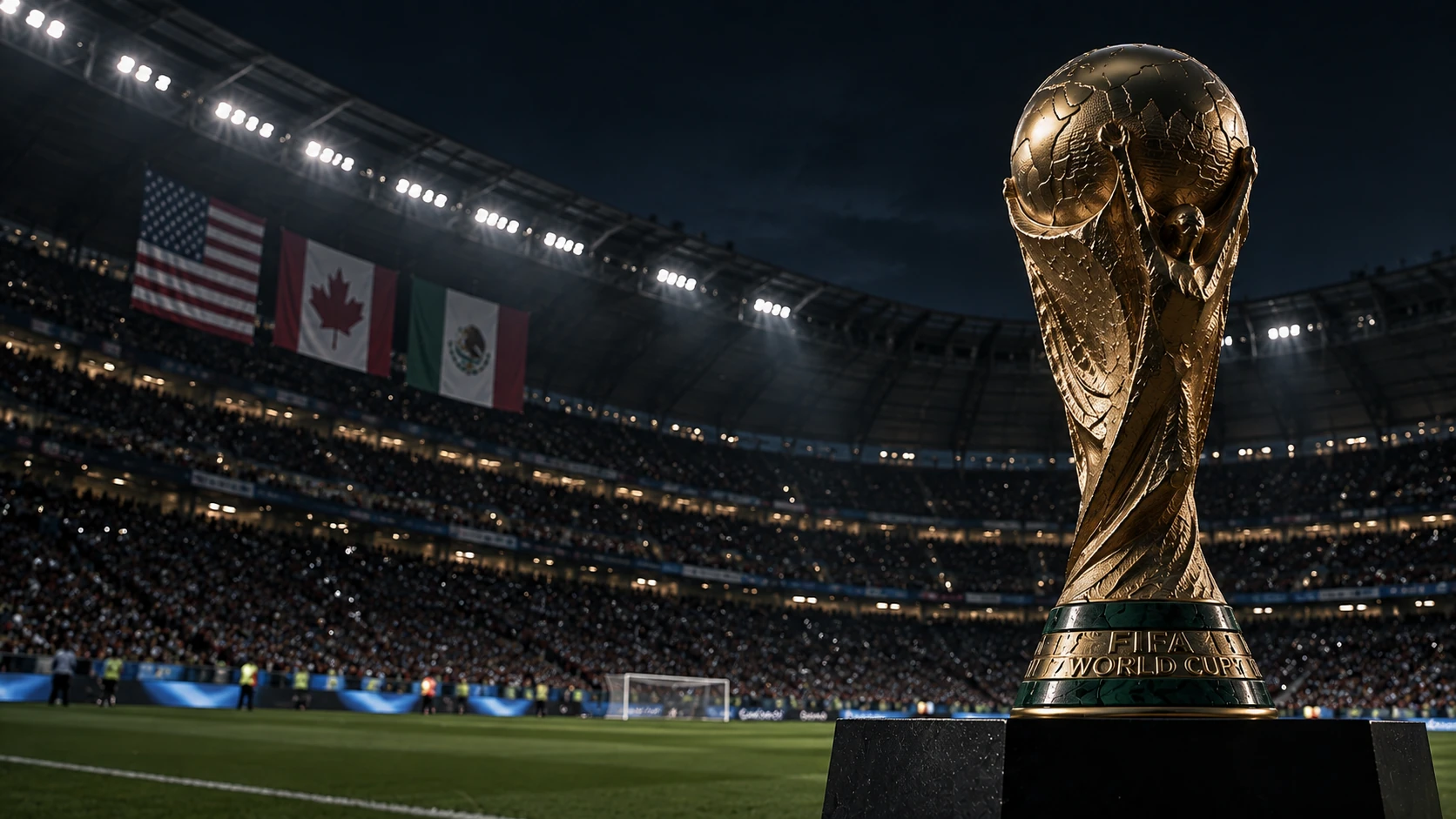
The FIFA World Cup 2026 was not simply a bigger World Cup. It was the first real test of a new tournament model: 48 teams, 104 matches, three host countries, 16 host cities and a competition stretched across Canada, Mexico and the United States.
By the time Spain beat Argentina 1-0 after extra time in the final at New York New Jersey Stadium on 19 July 2026, FIFA had a record-breaking event to sell and football had a more complicated question to answer. Did expansion make the World Cup richer, more inclusive and more global, or did it make the tournament harder to follow, more expensive and more commercially intense?
This evergreen guide separates final data from forecasts and estimates. FIFA's confirmed tournament figures are treated as final where available. Economic, tourism and visitor-impact numbers are labeled as official forecasts, preliminary local estimates or third-party analysis when full post-event audits have not yet been published.
For more PRESDA context, read our guide to World Cup 2026 sponsors, the political background in Donald Trump and World Cup 2026, and broader Sport coverage.
FIFA World Cup 2026 Key Facts
Tournament snapshot: Champion, Spain. Runner-up, Argentina. Final, Spain 1-0 Argentina after extra time at New York New Jersey Stadium. Dates, 11 June to 19 July 2026. Host countries, United States, Mexico and Canada. Teams, 48. Matches, 104. Venues, 16. Host cities, 16. Total attendance, 6,810,966. Average attendance, 65,490. Total goals, 308. Goals per match, 2.96.
The numbers explain why FIFA World Cup 2026 became a landmark. It had 40 more matches than the 32-team editions in 2018 and 2022. It also created an additional knockout layer, the Round of 32, and gave more nations a first or rare appearance on the world stage.
The 48-Team Format Explained
World Cup 2026 was the first men's edition to expand from 32 to 48 teams. The change increased representation across confederations and turned the event into a 104-match tournament. Instead of eight groups of four followed by a Round of 16, the expanded competition used twelve groups of four, then moved into a Round of 32.
The benefit was obvious: more teams, more markets, more national stories and more matches for fans and broadcasters. The cost was also obvious: a longer event, more travel, more squad management, more operational complexity and more uneven early-round matchups.
FIFA and Arsene Wenger defended the format as a success after the tournament, arguing that the new structure created competitive football and wider global participation. Critics focused on travel distance, ticket prices, schedule density and the risk that a bigger field can dilute the clarity of the event. Both readings can be true at once.
104 Matches Across Three Host Countries
The United States hosted the largest share of the tournament, while Mexico and Canada gave the event its continental identity. This was the first FIFA World Cup jointly hosted by three countries and the first spread across such a large geographic footprint.
That created one of the defining tensions of World Cup 2026. The tournament felt massive, open and global, but also difficult to move through. Teams and supporters had to plan around long flights, border rules, time zones, visa systems, hotel pricing and local transport differences.
From a media and commercial point of view, 104 matches meant more inventory: more kickoffs, more broadcast windows, more sponsorship exposure, more social clips and more ticketing opportunities. From a player and fan point of view, it meant the World Cup became less like a compact festival and more like a continent-scale season.
Host Cities And Stadiums
World Cup 2026 used 16 host areas: Atlanta, Boston, Dallas, Houston, Kansas City, Los Angeles, Miami, New York New Jersey, Philadelphia, San Francisco Bay Area and Seattle in the United States; Guadalajara, Mexico City and Monterrey in Mexico; and Toronto and Vancouver in Canada.
The venue list mixed NFL stadiums, iconic football history and modern multipurpose arenas. Mexico City's Estadio Azteca carried deep World Cup memory after 1970 and 1986. New York New Jersey Stadium hosted the final. Los Angeles, Dallas, Miami, Seattle, Toronto and Vancouver gave the tournament large media and travel markets.
Host-city table: United States, 11 host areas and 78 matches; Mexico, 3 host cities and 13 matches; Canada, 2 host cities and 13 matches. Final, New York New Jersey Stadium. Opening match, Mexico City at Estadio Azteca.
Attendance Records
FIFA reported an all-time record 6,810,966 fans across 104 matches, with an average crowd of 65,490 and 99.7 percent capacity across the 16 venues. That made World Cup 2026 the highest-attended tournament by total attendance.
The comparison needs context. The 1994 World Cup in the United States still mattered as the previous total-attendance benchmark, but it had 52 matches. The 2026 edition doubled the match count from 1994 and benefited from larger modern stadium inventory across North America.
Comparison table: 2026, 48 teams, 104 matches, 6,810,966 attendance, 308 goals. 2022, 32 teams, 64 matches, about 3.4 million attendance, 172 goals. 2018, 32 teams, 64 matches, about 3.0 million attendance, 169 goals. The cleanest conclusion is that 2026 broke total scale records, while comparisons per match require caution because the format changed dramatically.
Goals, Champion And Records
Spain won the tournament by beating Argentina 1-0 after extra time in the final. FIFA's official post-final coverage said Spain became the first team to win the 48-team edition, with Rodri receiving the trophy as captain.
FIFA reported 308 goals in 104 matches, an average of 2.96 per match. Its post-tournament coverage described that as the best goals-per-game ratio for a World Cup in 56 years and far above the 172 goals scored in Qatar 2022.
The individual awards completed the tournament story. FIFA's official awards coverage listed Rodri as Golden Ball winner, Kylian Mbappe as Golden Boot winner, Unai Simon as Golden Glove winner and Pau Cubarsi as Best Young Player. Those awards underlined the strange balance of the tournament: Spain controlled the trophy and several major individual prizes, while Mbappe still owned the scoring race.
TV, Streaming, Digital And Social Audiences
FIFA said television viewership records were broken in host nations and around the world, but final global TV and streaming totals were not fully available in the accessible FIFA material at the time of this update. That is important: audience claims should not be treated as final unless FIFA or rights-holders publish complete audited figures.
The digital picture is clearer in FIFA's own mid-to-late tournament reporting. Before the final, FIFA said its digital and social channels had generated 34 billion impressions and 2 billion engagements through the end of the quarter-finals. FIFA also said 5.2 billion people were estimated to have engaged with the tournament at least once by the conclusion of the Round of 16, with more than six billion expected by the time final engagement figures were released.
The strongest confirmed digital conclusion is that World Cup 2026 was not only a television product. It was a social-media, highlights, fan-festival and mobile-content event, with match clips, player stories, fan travel and sponsor campaigns moving across platforms throughout the tournament.
Fan Festivals And Public Viewing
FIFA said more than 9 million fans attended FIFA Fan Festivals across Canada, Mexico and the United States. Before the final, FIFA had already reported more than 8.5 million Fan Festival visits, and its final reaction coverage later raised that figure above 9 million, including more than 4.5 million in Mexico alone.
That matters because fan festivals are part of the economic and cultural story. They create public access for people without match tickets, expand sponsor visibility and push spending into city centers, restaurants, transit systems and entertainment districts.
They also reveal one problem with measuring a World Cup. Stadium attendance is precise. Fan-zone attendance, visitor spending and city-level economic effect are harder. The same person can attend multiple events, and local spending can be shifted rather than newly created.
Tourism And International Visitors
Tourism data for World Cup 2026 should be read in layers. Before the event, the U.S. Department of State said preparations expected roughly five to seven million international visitors across the U.S. host cities. Tourism Economics, an Oxford Economics company, forecast 1.24 million international visitors for the World Cup specifically, including 742,000 incremental trips that would not otherwise have happened.
For Canada, official British Columbia reporting projected approximately 350,000 spectators at BC Place and about one million additional out-of-province visitors to B.C. during the tournament and the following five years. The City of Toronto later cited preliminary Destination Toronto and Destination Ontario research indicating nine out of ten surveyed visitors were likely to return to Toronto for leisure travel within two years.
For Mexico, the federal tourism ministry reported that the World Cup gathered 7.8 million domestic and international travelers in the host cities and generated more than 42 billion pesos in tourism spending during the 8 June to 19 July period. Mexico City officials also reported large estimated economic effects tied to the tournament period. These are government-reported tourism/economic figures, not FIFA match statistics.
Economic Impact: What Is Final And What Is Estimated
The safest economic conclusion is that World Cup 2026 created large short-term activity in hospitality, transport, retail, media, sponsorship and local events, but that full net economic impact requires slower post-event accounting.
FIFA and the White House described the 2025 Club World Cup and 2026 World Cup together as anticipated to have an economic impact in the region of USD 40 billion with 200,000 jobs created. That is an official forecast/claim, not a final audited post-event result. Houston Sports Authority later cited Bank of America CEO Brian Moynihan as estimating approximately USD 40 billion in North American economic activity, including USD 20 billion in the United States, while also noting that the full impact was still being measured.
Local figures varied sharply. Houston reported more than 1.1 million people at World Cup-related events and more than 480,000 spectators at Houston Stadium. British Columbia's official pre-event economic assessment projected around CAD 1 billion in GDP for B.C. over the tournament and five years after. Mexico's tourism ministry reported more than 42 billion pesos in tourism spending in host cities. These are useful indicators, but they are not the same methodology.
Jobs, Infrastructure And Public Costs
World Cup economics are never only revenue. Host cities often spend on security, transport planning, temporary infrastructure, public safety, fan zones, staffing, communications and venue readiness. Some of that spending creates temporary jobs and useful upgrades. Some of it is a cost of hosting.
British Columbia's May 2026 update showed the trade-off clearly. The province said projected net core and essential provincial costs had been reduced from a high of CAD 145 million to a high of CAD 114 million, while federal support and local tax mechanisms helped offset costs. The same release projected significant long-term benefits, but those were still forecasts.
This is why claims that a World Cup creates a simple profit for host cities are usually too neat. FIFA owns the event and major commercial rights. Host governments and cities carry many local delivery costs. Local businesses can benefit, but the net public return depends on spending, tax receipts, visitor substitution, long-term tourism and whether infrastructure remains useful.
FIFA Revenue, Ticketing And Sponsorship
FIFA's financial model is built around broadcast rights, marketing and sponsorship, ticketing and hospitality, licensing and other tournament-linked revenue. FIFA's official 2023-2026 budget originally projected USD 11 billion in revenue for the cycle, later revised upward in 2024 reporting.
Independent reporting before and during the tournament suggested the 2026 cycle could exceed earlier projections, driven by the expanded match inventory, U.S.-market pricing, hospitality, sponsorship and media rights. However, final audited FIFA revenue for the full 2023-2026 cycle should be treated as pending until FIFA publishes its final annual financial report covering the full tournament year.
Ticketing became one of the strongest criticisms of the tournament. The expanded format created more seats and more matches, but premium pricing, hospitality packages and resale dynamics raised questions about whether the World Cup remained accessible to ordinary fans. Commercial success and public accessibility were two sides of the same debate.
Prize Money And Team Distributions
FIFA initially approved a record USD 727 million financial contribution for World Cup 2026, including USD 655 million in prize money and preparation funding for qualified teams. In April 2026, AP reported that FIFA increased the total prize pool to USD 871 million, with the winner receiving USD 51 million, the runner-up USD 34 million, and every team guaranteed at least USD 12.5 million.
The increase reflected both the commercial scale of the tournament and pressure from federations facing higher travel, hotel and operating costs across three large host countries. A 48-team World Cup pays more teams, but it also asks more teams to manage more complicated logistics.
Distribution table: Initial FIFA-approved contribution, USD 727 million. Reported increased 2026 prize pool, USD 871 million. Winner payment reported by AP, USD 51 million. Minimum guaranteed payment reported by AP, USD 12.5 million per team.
Benefits Of The 48-Team World Cup
The biggest benefit was representation. More teams meant more supporters could see their countries on the world's largest football stage. It also gave confederations outside Europe and South America a broader route into the tournament and created space for debutants and smaller football nations to become part of the global story.
The sporting benefit was volume. More matches created more moments, more goals and more storylines. FIFA's 308-goal figure helps the pro-expansion argument: the tournament did not become a low-scoring slog. It produced more football and, by FIFA's accounting, nearly three goals per match.
The business benefit was equally clear. More matches meant more broadcast windows, more ticketing, more digital content, more sponsor exposure and more local activation opportunities. For FIFA, the expanded format made commercial sense.
Problems With The 48-Team World Cup
The problems were mostly logistical and social. A larger tournament is harder to navigate for fans, teams, media and local authorities. Travel distance, time zones, visas, hotel pricing and transport planning became part of the World Cup experience in a way they rarely do at compact tournaments.
There were also fairness concerns. Expanded fields can create more mismatches, while added knockout rounds can increase fatigue and injury risk. Players entered the tournament after demanding club seasons, then faced a long, travel-heavy international event.
Finally, there was the accessibility problem. A record-breaking World Cup can still feel expensive and distant if ticket prices, travel costs and accommodation push ordinary supporters away from the biggest matches. That tension will follow FIFA into 2030.
Was World Cup 2026 Actually Successful?
By FIFA's own metrics, yes. World Cup 2026 broke attendance records, delivered 104 matches, produced 308 goals, filled venues at 99.7 percent capacity, drew millions to Fan Festivals and created huge digital engagement. Spain's final win over Argentina gave the tournament a clear sporting climax.
By a wider public-interest measure, the answer is more balanced. The event expanded access for national teams and generated enormous attention, but it also intensified concerns about cost, travel burden, commercialization and the economic risk carried by host cities.
The best judgment is that World Cup 2026 was successful as a spectacle and commercial product, partly successful as a tourism and city-branding project, and still unresolved as a model for sustainable mega-event hosting. It proved that a 48-team World Cup can work. It did not prove that every part of expansion is automatically good.
Final Word
FIFA World Cup 2026 will be remembered as the edition that made the tournament bigger than ever: 48 teams, 104 matches, three countries, record attendance, huge digital reach and a Spanish champion.
Its legacy is more complex than its numbers. The tournament showed football's unmatched ability to gather the world, but it also showed how modern mega-events concentrate money, logistics and public pressure. The 2026 World Cup was a success. The more important question is what FIFA, host cities and supporters learned from the scale of that success.
FAQ
Frequently Asked Questions
Who won the FIFA World Cup 2026?
Spain won the FIFA World Cup 2026, beating Argentina 1-0 after extra time in the final at New York New Jersey Stadium on 19 July 2026.
How many teams played in World Cup 2026?
World Cup 2026 was the first men's FIFA World Cup with 48 teams, expanded from the previous 32-team format.
How many matches were played at FIFA World Cup 2026?
FIFA World Cup 2026 had 104 matches across Canada, Mexico and the United States.
What was the total attendance at World Cup 2026?
FIFA reported total attendance of 6,810,966 fans, with an average crowd of 65,490 and 99.7 percent venue capacity.
How many goals were scored at World Cup 2026?
FIFA reported 308 goals in 104 matches, an average of 2.96 goals per match.
What was the economic impact of World Cup 2026?
Final audited economic impact varies by source and methodology. FIFA and U.S. official statements used forecasts around USD 40 billion and 200,000 jobs, while local governments and tourism bodies reported separate city or regional estimates.
Was the 48-team World Cup format successful?
By FIFA's metrics, the format was successful because it delivered record attendance, more goals and broader participation. The balanced view is that it also created challenges around travel, cost, schedule size and accessibility.
Which countries hosted FIFA World Cup 2026?
The tournament was jointly hosted by the United States, Mexico and Canada, the first men's World Cup staged across three countries.
PRESDA Dispatch
Stay Informed. Stay Aware.
A sharp briefing across AI, gaming, sport, business, world affairs, paparazzi, and lifestyle.