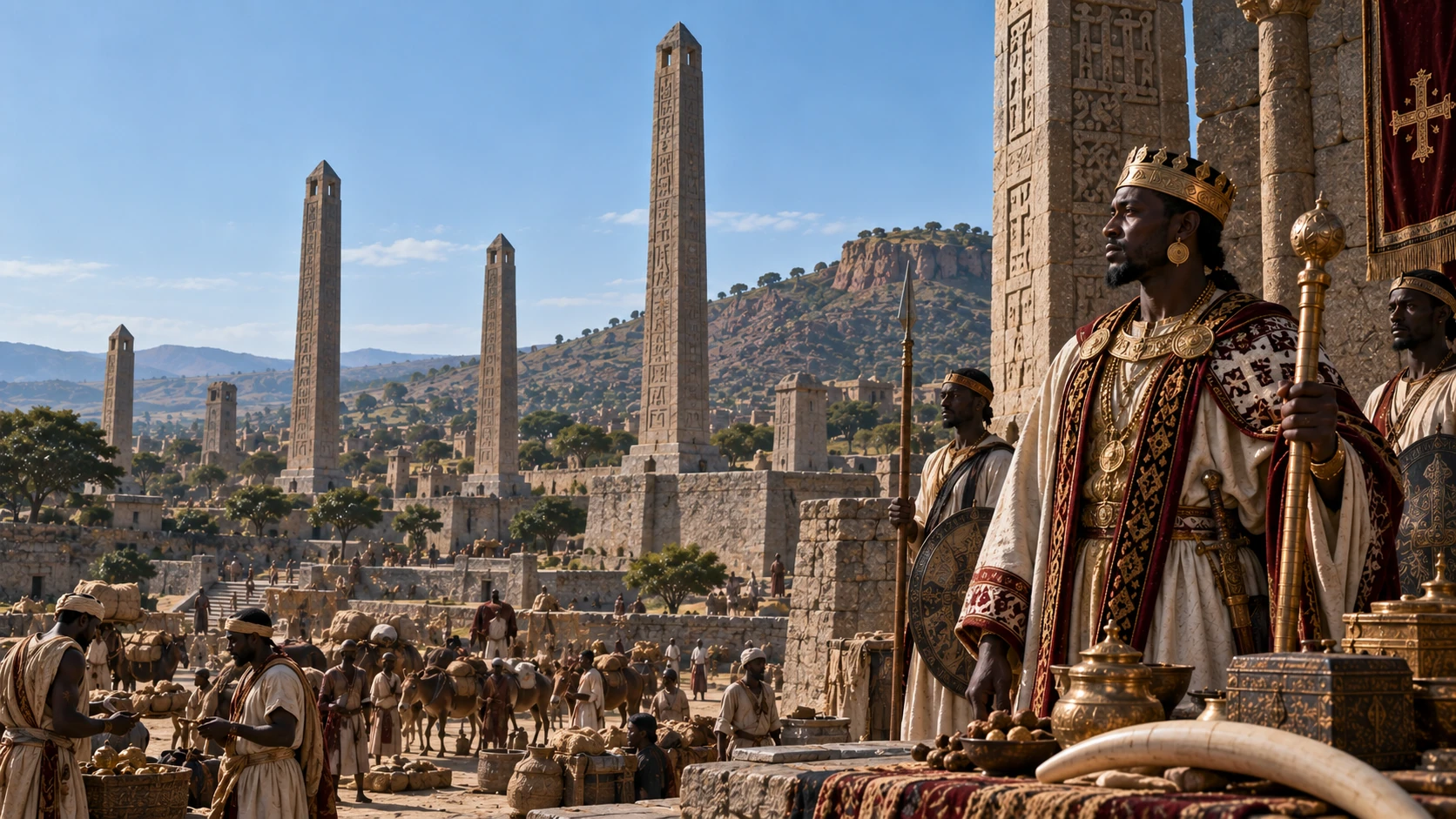
THE KINGDOM OF AKSUM: AFRICA'S ANCIENT POWER OF TRADE AND FAITH
From its highland capital and Red Sea port to Ezana's conversion and Kaleb's campaign in Yemen, Aksum connected Africa, Arabia and the wider ancient world.
The Kingdom of Aksum was an ancient highland power centered in present-day northern Ethiopia and Eritrea. Its capital, Aksum, stood inland on the Tigray plateau. The kingdom's principal Red Sea port was Adulis, on the Eritrean coast, and the two places formed a connected political and commercial system. From roughly the first century BCE through the first millennium CE, Aksum linked African producers with Arabia, the Roman and Byzantine worlds and Indian Ocean shipping. Its rulers minted coins, raised monumental stelae and adopted Christianity in the fourth century.
Aksum was locally rooted yet outward-looking. It was not a coastal city or simply an early version of the later Ethiopian Empire. Later rulers claimed Aksumite precedents and sacred traditions, but medieval and modern imperial states had different dynasties and territories. The Queen of Sheba and Ark of the Covenant stories belong to religious memory and should be distinguished from archaeological and written evidence.
ORIGINS IN THE HORN OF AFRICA
Aksum grew from northern Horn communities that farmed highland valleys, raised livestock and exchanged goods across the Red Sea. Earlier centers such as Yeha show monumental building and South Arabian connections. By the first centuries BCE and CE, a kingdom was consolidating authority around Aksum while incorporating regional traditions.
The highland capital stood near routes west toward the Nile and north toward the Red Sea. Adulis, several days' journey away, provided maritime access. Goods moved between port and interior by caravan, so Aksum's power depended on corridors, duties and relationships with local communities. UNESCO: Aksum
Aksumite inscriptions used Ge'ez, Sabaean and Greek. Greek connected the kingdom to Mediterranean commerce and diplomatic writing, while Ge'ez became a durable language of state and church. The evidence does not describe a single uniform people. It reveals a multilingual court ruling a diverse highland and lowland network.
ADULIS AND A RED SEA COMMERCIAL WORLD
Adulis was Aksum's major Red Sea port. Ships connected it to southern Arabia, Roman Egypt, the eastern Mediterranean and, through monsoon routes, the Indian Ocean. Ivory, gold, aromatics, hides and textiles moved outward; wine, oil, glass, metalware and ceramics came in. The port depended on inland African supply networks.
The first-century Greek sailing guide, the Periplus of the Erythraean Sea, describes Adulis as a market for African goods. Imported ceramics and glass confirm wider circuits. Aksum did not control every route or goldfield; its advantage was connecting producers, caravans and ships.
Gold and ivory were major exports. Cattle, salt, iron, aromatics and enslaved people also moved through the region, although sources do not permit precise totals. Trade enriched courts and merchants, not every household.
KINGS, GOVERNMENT AND COINAGE
Aksumite kings ruled through a court that mobilized armies, sponsored monuments and issued commands across changing territory. Inscriptions present kings as conquerors and guardians of order, not neutral administrators. The state relied on tribute, taxation, agriculture, route control and negotiated authority with local leaders.
Aksum was unusual among sub-Saharan African states of its period for issuing an independent coinage from the late third century into the early seventh century. Gold, silver and bronze coins carried royal portraits, crowns, crosses and inscriptions, often in Greek and sometimes in Ge'ez. Gold pieces circulated widely beyond the kingdom, while silver and bronze were more often found in northern Ethiopia, Eritrea and nearby regions. Coinage made the king's image and claims portable, and it helped facilitate transactions in international markets. British Museum: Aksumite Kingdom coinage
The coins document religious change. Earlier rulers used pagan symbols, while later issues display crosses and Christian formulas. The transition was gradual, and royal designs do not prove every subject converted, but they show kings announcing a new political identity.
STELAE, TOMBS AND THE ARCHITECTURE OF POWER
Aksum's most recognizable monuments are its carved stone stelae, often called obelisks. Most date to the third and fourth centuries and were erected in funerary landscapes. Their carved doors, windows and horizontal bands imitate multi-story buildings, turning a single stone into an image of an elite residence. Tombs and underground chambers lay nearby. The monuments commemorated prominent dead and displayed the resources of the court, quarry workers and engineers.
The tallest stelae were extraordinary technical projects, requiring stone to be quarried, shaped, transported and raised by organized labor. Some fell or broke. They were not Egyptian pyramids, and calling them only obelisks hides their local funerary meaning. Their architecture combined regional practice with ideas circulating across the Red Sea. Metropolitan Museum of Art: The monumental stelae of Aksum
Palaces, reservoirs, elite tombs and later churches formed a wider urban landscape. Archaeology cannot reconstruct every neighborhood, but it shows a capital supporting specialists, ritual institutions and long-distance exchange. UNESCO preserves ruins dating from the first to the thirteenth centuries.
AKSUM AND THE KINGDOM OF KUSH
Aksum interacted with the Nile world, including the later history of the Kingdom of Kush. Kush had been centered farther west in Nubia, first at Napata and later at Meroë, with its own political traditions and long chronology. Aksum and Kush were neighboring powers linked by trade, diplomacy and competition, not one continuous kingdom. PRESDA's Kingdom of Kush history follows the Nile state's earlier development in more detail.
King Ezana recorded campaigns against groups named in inscriptions, including the Bega and Kasu. These reached territories west of Aksum and regions associated with Kush. His texts claim victory and submission, but their geography and political language remain debated. They show ambition without proving permanent annexation.
Older popular histories say Ezana conquered and destroyed Meroë around 350 CE, ending Kush in one blow. That interpretation is debated. Meroë already faced political and economic difficulties, and one inscription cannot settle the relationship between Ezana's campaigns, Meroitic decline and later Nubian societies. Archaeology points to a longer transition. Aksum intervened as Kushite power changed; it did not necessarily erase Kush alone.
EZANA, FRUMENTIUS AND THE CHRISTIAN KINGDOM
Ezana's reign marks a major change in Aksumite history. A Christian narrative preserved by Rufinus says two shipwrecked Syrian brothers, Frumentius and Aedesius, entered the royal household. Frumentius later returned as a bishop from Alexandria. The story reflects ecclesiastical memory, yet inscriptions and coins independently show Ezana's movement toward Christian language and the cross.
Christianity became established at court and in urban institutions during the fourth century without instantly erasing older practices. Aksumite society remained diverse, and conversion outside the court is difficult to measure. Christianity connected Aksum to Egypt and the eastern Roman world while developing local forms through Ge'ez scripture and clergy. The kingdom still differed from the medieval Solomonic empire.
Ezana's inscriptions also use the name Ethiopia in a political context. His monuments combine military narratives, divine authority and claims over trade corridors, providing a rare first-hand record of an African king addressing several audiences.
ROME, BYZANTIUM AND ARABIA
Aksum maintained relations with Roman and Byzantine Egypt through trade, diplomacy and Christianity. Mediterranean writers valued its ivory and described a significant power beyond the Red Sea. Gold coins found far from the highlands show circulation or diplomatic movement, though each find has its own context. Aksum was never a Roman province.
Arabia was closer and contested. Aksumite rulers intervened in South Arabia when alliances, trade and religious conflict converged. In the early sixth century, the Himyarite king Dhu Nuwas persecuted Christians in Najran according to several traditions. King Kaleb sent an army across the Red Sea, defeated Himyarite forces and installed a Christian ruler. The Aksumite-backed regime was later challenged by local politics and Persian intervention. British Museum: Kaleb and the Red Sea world
Kaleb's campaign shows both the reach and limits of Aksumite power. The kingdom could transport armies across the sea, yet Yemen was not simply an Aksumite province. Control depended on allies, garrisons and changing Arabian conditions, while diplomacy exposed Aksum to rivalry with Sasanian Persia.
AKSUM AT ITS HEIGHT
By the fifth and sixth centuries, Aksum was a major state between the eastern Roman Empire and Persia. Its influence extended across the northern Horn, the Red Sea and, at times, South Arabia. Monuments and coinage reflected wealth from agriculture, tribute and commerce. Adulis handled maritime exchange while roads connected it to Aksum and African sources of ivory and gold.
The kingdom was not centralized in the modern sense. Borders shifted, local rulers retained power and campaigns had different results. Authority was strongest where the court combined force with tribute, religious legitimacy and transport control, allowing global connections without direct rule over every neighbor.
DECLINE AFTER THE SEVENTH CENTURY
Aksum's decline was gradual and multi-causal. From the seventh century, Muslim polities changed Red Sea diplomacy and reduced some routes to Mediterranean markets. Political competition, pressure on agriculture, changing rainfall and the costs of distant relationships may also have weakened the court. Adulis declined over time, but no single invasion or disaster explains the process.
As maritime commerce shifted, political centers moved within the highlands. Aksum remained sacred, but other centers gained power. Later Christian kingdoms preserved Ge'ez traditions and Aksumite memories while developing new capitals and dynasties. The transition was adaptation and reorganization, not an overnight collapse.
LEGACY IN ETHIOPIA AND ERITREA
Aksum's legacy is visible in Ethiopian and Eritrean landscapes, languages, religious traditions and national histories. Its stelae and ruins are evidence of a sophisticated African state, not monuments requiring a foreign builder. The city remains an Ethiopian Orthodox pilgrimage center, while Adulis anchors Eritrea's maritime history. UNESCO protects the ensemble, though conservation challenges remain.
The later Ethiopian Empire drew on Aksumite memory, Christianity and northern sacred sites, but it was a distinct formation. Its Solomonic dynasty emerged in 1270 after the Zagwe period, centuries after Aksum's political order changed. PRESDA's Ethiopian Empire history traces that state and explains why continuity is not an unbroken government.
Aksum combined local state-building with international connection. It made the Red Sea a space of African power, used coins and inscriptions to project authority, adopted Christianity through its own institutions and negotiated with Kush, Arabia, Rome and Byzantium. It remains an ancient center of trade and faith, remembered through evidence and living traditions that must be kept distinct from established history.
FREQUENTLY ASKED QUESTIONS
**Was Aksum a coastal city?**
No. Aksum was an inland highland capital in present-day northern Ethiopia. Adulis, on the Eritrean Red Sea coast, was its major port and maritime gateway.
**Did Aksum destroy the Kingdom of Kush?**
Aksumite kings, especially Ezana, campaigned westward as Kushite power was changing, but the claim that Aksum alone destroyed Meroë around 350 CE is debated. Kush's decline was a longer process with political and economic causes that remain under study.
**When did Aksum become Christian?**
Christianity became established at the Aksumite court in the fourth century, during the reign of Ezana. The tradition of Frumentius explains the conversion, while inscriptions and coins provide independent evidence for the king's changing religious identity.
**What was Aksum's port?**
Adulis was the principal Red Sea port. It connected the inland capital and African trade routes to Arabia, Roman and Byzantine markets and Indian Ocean shipping.
**Is Aksum the same as the later Ethiopian Empire?**
No. Aksum was an ancient kingdom of the first millennium. The later Ethiopian Empire developed through different dynasties and institutions, although its rulers preserved Aksumite memories and Christian traditions.
> Aksum was an inland African kingdom whose roads, coins and port connected highland power to the Red Sea and the wider ancient world.
FAQ
Frequently Asked Questions
Was Aksum a coastal city?
No. Aksum was an inland highland capital in present-day northern Ethiopia. Adulis, on the Eritrean Red Sea coast, was its major port and maritime gateway.
Did Aksum destroy the Kingdom of Kush?
Aksumite kings campaigned westward as Kushite power was changing, but the claim that Aksum alone destroyed Meroë around 350 CE is debated. Kush's decline was a longer process.
When did Aksum become Christian?
Christianity became established at the Aksumite court in the fourth century, during the reign of Ezana. Frumentius is central to the conversion tradition, while coins and inscriptions provide independent evidence.
What was Aksum's port?
Adulis was the principal Red Sea port, connecting Aksum to Arabia, Roman and Byzantine markets and Indian Ocean shipping.
Is Aksum the same as the later Ethiopian Empire?
No. Aksum was an ancient first-millennium kingdom. The later Ethiopian Empire developed through different dynasties and institutions, although it preserved Aksumite memories and Christian traditions.
PRESDA Dispatch
Stay Informed. Stay Aware.
A sharp briefing across AI, gaming, sport, business, world affairs, paparazzi, and lifestyle.