KINGDOM OF KUSH: THE AFRICAN EMPIRE THAT CONQUERED EGYPT
From the kingdoms of ancient Nubia to the pharaohs who ruled Egypt, the story of Kush, its pyramids, powerful queens and enduring African legacy.
From the Nile, a mountain rises abruptly above the desert near modern Karima in Sudan. To the rulers who built temples beneath Jebel Barkal, this was a sacred landscape. From this region came a dynasty that marched north, took control of Egypt and claimed the authority of the pharaohs. Yet its history neither began nor ended at the Egyptian frontier.
The Kingdom of Kush was a major African power centered in what is now Sudan. Its rulers controlled Egypt as the Twenty-fifth Dynasty in the eighth and seventh centuries BCE, then continued ruling farther south through the Napatan and Meroitic periods. Kush was a distinct political tradition within ancient Nubia, deeply connected to Egypt but never adequately explained as an Egyptian imitation. British Museum: Sudan, Egypt and Nubia
Its story belongs to farmers, herders, traders and metalworkers as well as kings. It includes queens whose authority was represented in monumental art, a writing system that scholars can read aloud more easily than they can fully translate, and royal cemeteries that transformed the pyramid into a distinctive Nubian monument. Understanding Kush requires following these developments across centuries rather than stopping at its most famous conquest.
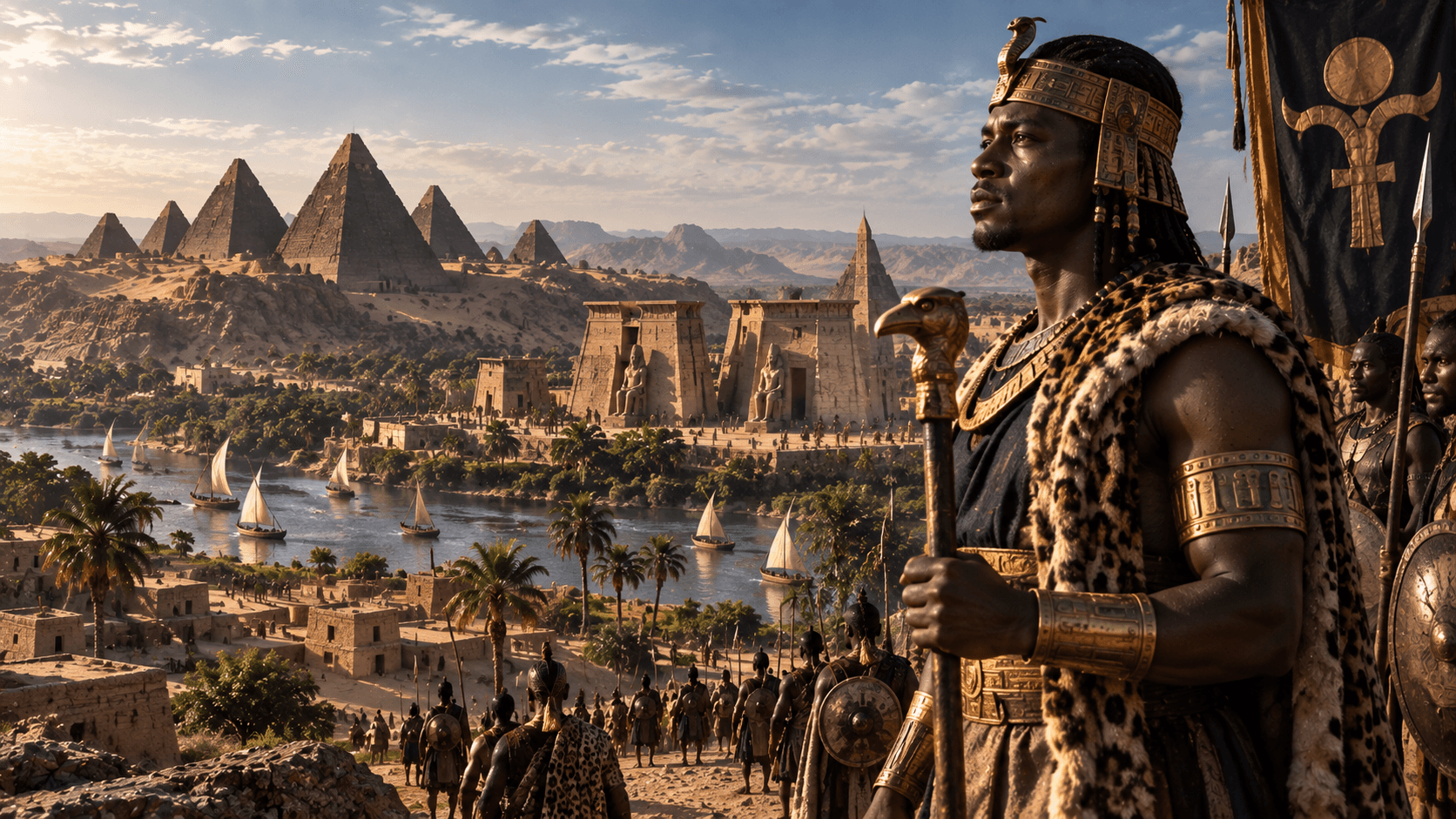
The supplied hero is an imaginative editorial illustration combining a ruler, Nile landscape, temples and pyramids. It is not an archaeological reconstruction of a particular reign or place.
WHERE WAS THE KINGDOM OF KUSH, AND WAS IT THE SAME AS NUBIA?
Nubia is a geographical and historical region along the Middle Nile, covering parts of southern Egypt and northern Sudan. Kush refers to kingdoms and political power within that region. The terms overlap, but they are not interchangeable: Nubia existed before, during and after Kushite imperial rule, and its communities were never culturally uniform. Metropolitan Museum of Art: The Land of Nubia
The Nile connected settlements while its cataracts, stretches of rocky rapids, complicated travel. River routes intersected with desert tracks linking agricultural land, grazing areas and mineral resources. This was a landscape of movement and negotiation, not an empty corridor separating more important civilizations. Egypt and its southern neighbors exchanged objects, people and religious practices while repeatedly competing for territory and resources.
For the longer northern history, PRESDA's Ancient Egypt article follows the pharaonic state across its changing dynasties. Kush's history intersects with that account, but it also has its own centers, chronology and political ambitions.
A short chronology of Kush
Approximately 2500–1500 BCE: Kerma developed into a powerful kingdom in Upper Nubia. During the second millennium BCE, Egyptian conquest brought much of Nubia under New Kingdom control. By the early first millennium BCE, an independent southern monarchy was emerging again around Napata.
Late eighth to seventh century BCE: Kushite kings ruled Egypt as its Twenty-fifth Dynasty. Assyrian invasions ended their northern empire, not the Kingdom of Kush. In the following centuries, Meroë became increasingly important; from around the third century BCE it was the principal royal burial center. Central Meroitic power declined by the fourth century CE. These broad phases describe gradual changes, and scholarly period boundaries vary.
KERMA: AN AFRICAN KINGDOM BEFORE THE KUSHITE PHARAOHS
Long before Piye entered Egypt, Kerma stood near the Third Cataract in present-day Sudan. Excavations reveal an urban center, fortifications, monumental mudbrick buildings and extensive cemeteries. The surviving deffufas, massive structures associated with religious activity, demonstrate architectural traditions that cannot be reduced to Egyptian pyramid building. Kerma archaeological mission: Historical overview
Kerma's strength rested on an agricultural and pastoral economy and on access to exchange routes. Cattle, ivory, gold and other valuable materials helped connect its rulers with wider networks. Its royal tombs expressed enormous differences in status. This was an organized and unequal society with its own political center, rather than a waiting room for Egyptian civilization.
Egyptian expansion during the New Kingdom overturned this balance. The conquest established temples, settlements and systems of administration in Nubia. It also intensified cultural exchange under unequal conditions. Egyptian gods and royal imagery became embedded in local landscapes, but conquest did not erase the people or histories already there. The Museum of Fine Arts, Boston places the occupation broadly between the mid-sixteenth and eleventh centuries BCE. Museum of Fine Arts, Boston: Ancient Nubia Now
When Egyptian imperial authority weakened, the south did not simply revert to its earlier form. New rulers inherited a world changed by centuries of interaction. The later Kushite monarchy used some Egyptian institutions and symbols while building authority in Nubian communities and sacred places. Cultural borrowing could become a language of independence.
NAPATA: THE SACRED LANDSCAPE BEHIND A NEW POWER
Napata was associated with the region around Jebel Barkal, where temples linked kingship to Amun. The mountain and neighboring sites formed a ceremonial landscape rather than a single isolated monument. UNESCO's designation includes Jebel Barkal, El-Kurru, Nuri, Sanam and Zuma, preserving temples, palaces and funerary remains from different phases of Kushite history. UNESCO: Gebel Barkal and the Sites of the Napatan Region
Religion was part of political power. A king recognized by an important sanctuary could present military expansion as the restoration of proper order. The connection between Amun's worship in Nubia and Egypt gave Kushite rulers a particularly effective claim: they could enter Egypt as conquerors who also presented themselves as protectors of its sacred traditions. That claim served royal interests; it was not a neutral description of their neighbors' government.
HOW DID KUSH CONQUER EGYPT?
Kush conquered Egypt through a combination of military campaigning, influence in Upper Egypt and agreements imposed on competing local rulers. Piye's campaign, conventionally dated around 728 BCE, was decisive. He entered a politically divided Egypt, defeated opponents and secured submissions rather than instantly replacing every regional authority with a new centralized administration. British Museum and Smarthistory: King Piye and Kushite control of Egypt
The north was not governed by one strong, united pharaoh. Regional powers included rulers of Libyan ancestry, and coalitions could shift. A Brooklyn Museum relief of Iuput II identifies one of the rulers who submitted to Piye, turning an abstract account of conquest into evidence for the survival and subordination of particular local dynasties. Brooklyn Museum: Relief of Iuput II
Piye's Victory Stela narrates campaigning, siege operations and surrender, framing the king as a ruler favored by the gods. Its attention to ritual and royal conduct is as important as its military narrative: Piye wanted to establish why his authority was legitimate. A victory inscription records a court's presentation of events, not an impartial campaign diary. Piye Victory Stela: Translation and source notes
The conquest therefore involved more than an army moving downriver. It joined force to a persuasive political vocabulary already understood in Egyptian temples and courts. Piye's success opened the way for a Kushite dynasty whose successors exercised more sustained control over Egypt. It did not make Egypt and Kush culturally identical.
THE BLACK PHARAOHS OF EGYPT
The phrase “Black Pharaohs” commonly describes the Kushite rulers of Egypt's Twenty-fifth Dynasty. It usefully draws attention to an African dynasty often marginalized in older popular histories. It is a modern label, however, not the name of an ancient political party or a precise ancient racial classification. Both Egypt and Kush were African societies, and modern racial categories cannot simply be mapped onto their populations.
Older scholarship sometimes treated Nubian achievements as derivatives of Egypt. The Museum of Fine Arts' Ancient Nubia Now exhibition explicitly examined how racism and other biases shaped archaeological interpretation. Correcting those distortions means taking Nubian evidence seriously, not replacing one simplistic hierarchy of civilizations with another.
Taharqa, who ruled from 690 to 664 BCE, is among the dynasty's best-documented kings. Monumental building helped make his authority visible. A shrine from his temple at Kawa, now in the Ashmolean Museum, preserves the religious and architectural world of his kingship. Such works matter because imperial power was enacted through construction and worship as well as warfare. Ashmolean Museum: Taharqa’s Shrine
The Ashmolean's ram of Amun-Re shelters a small figure of Taharqa beneath its head. It is an image of divine protection, with the king's authority expressed through a sacred animal. Objects like this show how Kushite rulers selected and developed shared religious imagery for their own royal purposes. Ashmolean Museum: Ram of Amun-Re
KUSH VS ASSYRIA: WHY THE NORTHERN EMPIRE ENDED
Kushite Egypt confronted a second expansionist power: Assyria. The conflict belonged to a wider struggle over the eastern Mediterranean, where Egyptian and Kushite interests intersected with Assyrian campaigns and local resistance. It was not simply an isolated contest between two kings. PRESDA's Assyrian Empire history explains the military and administrative system behind that rival power.
In 671 BCE, Esarhaddon's forces captured Memphis. Assyrian accounts celebrated the defeat of Taharqa and the capture of members of his household. These inscriptions are evidence for major military events, but their triumphal language also advertised Assyrian dominance to audiences across the empire. British Museum scholarship: Esarhaddon in Egypt
Control remained contested. Taharqa regained ground before further Assyrian intervention under Ashurbanipal. After Taharqa's death in 664 BCE, his successor Tantamani, also called Tanwetamani, attempted to recover the northern kingdom. The Assyrian sack of Thebes in 663 BCE was a devastating turning point. Kushite rule in Egypt ended through repeated campaigns and political reversals, not one final battle that destroyed Kush itself. British Museum: Egypt and Sudan Newsletter 6, 2019
The distinction matters. Retreat from Egypt reduced the reach of the dynasty, but its southern institutions, temples and ruling traditions endured. Telling Kush's story only through its Egyptian reign makes centuries of subsequent African history disappear from view.
FROM NAPATA TO MEROË: A GRADUAL TRANSFORMATION
Meroë did not suddenly appear when the Kushites lost Egypt. Archaeological evidence places royal activity there much earlier than its best-known pyramids. UCL's overview notes objects bearing the name of Aspelta, a king of the late seventh and early sixth centuries BCE. The city was already part of the kingdom's political geography. UCL Digital Egypt: Meroe
An Egyptian expedition under Psamtek II in 593 BCE damaged the Napatan region, but a simple story in which this raid forced an immediate, permanent capital move is misleading. The Jebel Barkal archaeological project emphasizes continued building and the later transfer of most royal burials toward Meroë around 270 BCE. Political residence, ritual authority and royal burial did not have to move together. Jebel Barkal Archaeological Project: Historical summary
The so-called Island of Meroë is a region between the Nile and Atbara rivers, not a small island occupied by one city. Its archaeological landscape includes Meroë itself and major centers such as Naqa and Musawwarat es-Sufra. Temples, settlements, cemeteries and water installations reveal a kingdom spread across different environments. UNESCO: Archaeological Sites of the Island of Meroe
HOW DID NILE TRADE AND EVERYDAY WORK SUSTAIN KUSH?
A royal court could command resources only because people produced food, tended animals, transported goods and made useful objects. River traffic linked communities; routes away from the Nile extended the reach of exchange. Water storage was especially important beyond the riverbanks. UNESCO's Meroë assessment identifies reservoirs and other infrastructure alongside the better-known monuments.
Craftsmanship reveals connections that political histories can miss. Goldwork from Nubian royal burials includes elaborate jewelry and protective imagery. Such objects demonstrate skilled workshops and access to valuable materials, but a queen's treasure is not a representative picture of an ordinary household's possessions. Museum of Fine Arts, Boston: Gold and the Gods
Kush belonged to networks linking northeastern Africa with the Mediterranean and regions farther south. That does not mean it controlled every route or that all trade was royal. Archaeologists reconstruct exchange from objects, materials, settlements and routes; the resulting picture is more uneven than an ancient map with neat commercial borders would suggest.
Was Meroë an iron-producing powerhouse?
Iron production was an important part of Meroë's economy, and large slag deposits preserve evidence of sustained metalworking. Research by Jane Humphris and Thomas Scheibner used radiocarbon evidence to investigate a production history extending across more than a millennium, potentially beginning during the Twenty-fifth Dynasty and continuing beyond the end of Kushite rule. Humphris and Scheibner, African Archaeological Review: A new chronological framework for Meroitic iron production
Making iron required more than knowing that ore could become metal. Fuel supplies, furnace construction, air control and skilled labor had to work together. Technical research investigates these practices through archaeological remains rather than treating slag heaps as a direct measure of national wealth. Charlton and Humphris: Exploring ironmaking practice at Meroe
The evidence supports describing Meroë as an important center of ironworking. It does not establish that Kush invented iron smelting for the whole of Africa, dominated all continental production or collapsed simply because its furnaces consumed every tree. Those much larger claims require evidence that the existence of an impressive industrial landscape cannot supply by itself.
WHY ARE THERE SO MANY PYRAMIDS IN SUDAN?
Sudan's numerous pyramids reflect a long Kushite tradition of royal and elite burial, distributed across successive cemeteries and generations. Kings and royal women received monumental tombs. The monuments accumulated because pyramid burial remained significant in Kush long after Egypt's most famous Old Kingdom pyramids had been built.
El-Kurru, Nuri and the Meroë cemeteries belong to different stages of that history. Many Nubian pyramids are smaller and steeper than the great monuments at Giza. Their significance lies in their own funerary arrangements and religious setting, not in winning a competition with Egypt over size or quantity. The UNESCO Napatan listing documents the relationship between these cemeteries and surrounding sacred centers.
A British Museum relief from a Meroë pyramid chapel helps explain the arrangement: commemorative and offering spaces stood above ground, while burial chambers could be reached underground by stairs. Looking only at the pyramid's silhouette misses the practices that connected the living to the deceased. British Museum: Relief from the chapel of Meroe pyramid N11
Exact national totals vary with what is counted and how ruined structures are classified. A single viral number is less useful than understanding why these cemeteries exist. They preserve a sequence of royal memory, religious adaptation and skilled building that lasted for centuries.
GODS, TEMPLES AND A LANGUAGE NOT YET FULLY UNDERSTOOD
Kushite religion combined traditions shared with Egypt with distinct local developments. Amun remained important, while the lion-headed god Apedemak became prominent in Meroitic monumental art. At Naqa, temples and royal imagery make this combination visible: shared forms did not prevent a specifically Kushite religious world from developing. American Society of Overseas Research: Ancient Nubia educational resource
Writing also changed. Kushite rulers used Egyptian writing in royal and religious settings, but Meroitic scripts were developed to record the Meroitic language. The system is often loosely called an alphabet; specialists Claude Rilly and Alex de Voogt explain its structure more precisely as an alphasyllabary, in which consonant signs normally include an inherent vowel. Rilly and de Voogt, Cambridge University Press: Meroitic Writing
Meroitic is not wholly unreadable. The sound values of its signs were deciphered in the early twentieth century, and scholars understand names, titles and parts of recurring formulas. Understanding the language well enough to translate every surviving text is a different problem. Rilly describes translation as continuing, painstaking work rather than a mystery that has never yielded any information. Claude Rilly, College de France: The patient translation of Meroitic texts
That gap limits the history we can write. A monument may identify royal people without giving historians a secure translation of every event it describes. Responsible accounts should acknowledge that uneven access rather than fill missing passages with an exciting invented narrative.
THE KANDAKE QUEENS: WOMEN AND ROYAL AUTHORITY
Kandake was a royal title associated with queens or queen mothers, not the personal name of one woman. The form Candace appears in Greek and Roman transmission. Royal women could hold major political and religious authority, although their positions varied across periods and individuals.
Angelika Lohwasser's study of Kushite queenship examines royal women's roles in legitimacy, ritual and representation. Their prominence challenges the assumption that ancient monarchy was always exclusively male. It does not prove that every woman in Kush enjoyed equal rights or that the entire society was governed by a single unchanging matriarchal system. Angelika Lohwasser, Journal of the American Research Center in Egypt: Queenship in Kush
Amanitore provides a particularly visible example from the Meroitic period. A bark stand from Wad ban Naqa, held in Berlin, associates her with King Natakamani. Royal imagery and temple patronage made their authority public. Their partnership should not be reduced to an unsupported assumption about their exact family relationship. Staatliche Museen zu Berlin: Bark stand of Natakamani and Amanitore
A different queen, Amanirenas, is associated with the confrontation with Rome in the late first century BCE. The Hamadab stela names Amanirenas and Akinidad, but the incomplete understanding of its Meroitic text means it cannot be treated as a fully translated chronicle of that war. British Museum: Hamadab stela
KUSH AND ROME: WAR, NEGOTIATION AND INDEPENDENCE
After Rome took Egypt, Kush faced a new imperial neighbor. In campaigns around 25–24 BCE, Kushite forces attacked the southern Egyptian frontier and carried away images of Augustus. A bronze head of the emperor, discovered at Meroë, provides material evidence of that confrontation. British Museum: The Meroe Head of Augustus
Its placement beneath a temple entrance has been interpreted as a deliberate humiliation of the emperor: people could pass above the defeated image. The object's archaeological context matters more than a modern slogan claiming that one side effortlessly crushed the other. National Museum of Australia: Rise of the empires, British Museum curator lecture
Strabo describes a Roman counteroffensive under Petronius, including the capture and destruction of Napata. He also records renewed Kushite pressure and an embassy to Augustus at Samos, followed by concessions and the remission of imposed tribute. This is a Roman-era account with its own prejudices and triumphal claims; its reported army sizes should not be repeated as independently verified statistics. Strabo, Geography 17.1.54: Roman and Kushite campaigns
A settlement around 20 BCE stabilized relations. Kush remained independent. That outcome is significant without pretending that Kush conquered Rome or that Roman forces never inflicted serious damage. Military resistance and diplomacy together produced a durable alternative to annexation.
WHAT HAPPENED TO THE KINGDOM OF KUSH?
Kushite central power declined during the later Meroitic period and had fragmented by the fourth century CE. The end was a transformation of political authority, not the sudden disappearance of the population. Changing regional power, economic relationships and external conflict all belong in the investigation, but their relative importance remains debated.
One interpretation links Meroë's final decline to fourth-century expansion by Aksum, the kingdom centered in what is now northern Ethiopia and Eritrea. The Oxford Handbook of Ancient Nubia's chapter on Meroë treats an Aksumite intervention as a final blow following earlier decline. That is an important scholarly interpretation, not a universally established destruction date. Oxford Handbook of Ancient Nubia: The City of Meroe
Other scholarship is more cautious. Mahmoud El-Tayeb's treatment of post-Meroitic Upper Nubia stresses the problems with invasion-based explanations and the lack of decisive archaeological confirmation for familiar scenarios. The popular sentence that one ruler destroyed the whole Kingdom of Kush in exactly 350 CE compresses disputed evidence into false certainty. Mahmoud El-Tayeb, Oxford Handbook of Ancient Nubia: Post-Meroitic Upper Nubia
Political fragmentation produced new regional societies whose material culture retained connections with earlier traditions. Later Christian kingdoms, including Nobadia, Makuria and Alwa, emerged in the Nile valley. The history of Nubia continued under new institutions and religious systems. Oxford Handbook of African Archaeology: The Medieval and Post-Medieval Nile Valley
MYTH VS REALITY: KUSH AND ANCIENT NUBIA
Myth: Kush was simply another name for Egypt. Reality: Kush was a separate southern kingdom with changing centers and traditions. Its rulers could adopt Egyptian symbols, compete with Egyptian rulers and eventually govern Egypt without losing their distinct political origins.
Myth: Kush ended when the Black Pharaohs left Egypt. Reality: the northern empire ended in the seventh century BCE, while Kushite political and cultural history continued for many centuries farther south.
Myth: Sudan's pyramids prove that all Egyptian civilization came from Kush. Reality: Nubian pyramid traditions are important in their own right. A shared architectural form does not establish that one society invented every achievement of another.
Myth: every Kandake was a warrior queen called Candace. Reality: Kandake was a title. Royal women's roles differed, and evidence for one queen's campaigns cannot be assigned to all queens.
Myth: nobody can read any Meroitic writing. Reality: scholars know the script's sound values and understand portions of its texts. Much of the language remains incompletely understood, which limits confident historical translation.
Myth: Kush was a civilization lost to everyone until foreign explorers found it. Reality: monuments remained part of inhabited landscapes. Archaeological investigation has expanded knowledge, but the history of discovery also includes local knowledge, collecting, colonial institutions and changing interpretations. Penn Museum's account of excavating and displaying Nubia illustrates how modern collections themselves have histories. Penn Museum: Digging and Displaying Ancient Nubia
THE LEGACY OF KUSH
Kush changes the scale of ancient history. It places a Sudanese monarchy at the center of Egyptian politics, connects the Mediterranean world to societies along the Middle Nile and reveals royal traditions in which women could occupy conspicuous positions of power. It also leaves unanswered questions that future excavation and linguistic research may clarify.
African history has many such centers, separated by distance and time. The much later Mali Empire and Mansa Musa belong to a different West African setting, while the history of the Amazigh follows diverse societies across North Africa. Reading these histories together expands the picture without turning the continent into one civilization.
The monuments of Kush are impressive, but their most important lesson is not that an overlooked kingdom deserves a place in a ranking. They preserve evidence of people making institutions, adapting religious ideas, organizing work and negotiating power. Egypt's Kushite pharaohs were one extraordinary chapter in that longer human history.
FAQ
Frequently Asked Questions
Where was the Kingdom of Kush?
Kush was centered along the Nile in present-day Sudan. At its greatest northern extent, its rulers also controlled Egypt as the Twenty-fifth Dynasty.
Were Kush and Nubia the same?
Not exactly. Nubia is a geographical and historical region extending across parts of southern Egypt and northern Sudan. Kush refers to kingdoms and political power within that wider region.
How did Kush conquer Egypt?
Piye combined military campaigns with existing influence in Upper Egypt and submissions from rival Egyptian rulers. His decisive campaign around 728 BCE established the basis for Kushite dynastic rule.
Who were the Black Pharaohs?
The term commonly describes the Kushite rulers of Egypt’s Twenty-fifth Dynasty, including Piye and Taharqa. It is a modern description, not an ancient racial classification.
Why does Sudan have so many pyramids?
Kushite rulers and royal women used pyramid tombs over many generations at successive cemeteries. Sudan’s pyramids reflect a long local funerary tradition, much later than Egypt’s famous Old Kingdom pyramids.
Who were the Kandake queens?
Kandake was a royal title associated with queens or queen mothers. Women such as Amanirenas and Amanitore exercised prominent authority, but the title did not imply an identical role for every holder.
Did Rome conquer Kush?
Roman forces campaigned in Kush and attacked Napata, but they did not annex the entire kingdom. Warfare was followed by a negotiated settlement, and Kush retained its independence.
What caused the Kingdom of Kush to decline?
Central Meroitic power weakened and fragmented by the fourth century CE. Scholars debate the roles of changing economic and regional relationships and external conflict, including Aksumite intervention. No single cause is securely established.
PRESDA Dispatch
Stay Informed. Stay Aware.
A sharp briefing across AI, gaming, sport, business, world affairs, paparazzi, and lifestyle.