MAGIC AND THE PARANORMAL: CAN SUPERNATURAL POWERS BE PROVEN?
For centuries, humans have believed in magic, curses, psychic powers and supernatural forces. Then skeptics such as James Randi asked a simple question: can any of them work under controlled conditions?
For thousands of years, humans have told stories about forces that appear to exist beyond the ordinary laws of nature.
Magic.
Curses.
Prophecy.
Spirits.
Telepathy.
Clairvoyance.
Healing powers.
People across different civilizations have interpreted unexplained events through supernatural ideas.
Even in the modern world, millions of people continue to believe that certain individuals can predict the future, communicate with spirits, manipulate invisible energies or influence events through supernatural means.
But science approaches the question differently.
It does not begin by asking whether an idea sounds strange.
It asks: can we test it?
Can we measure it?
Can someone demonstrate the claimed ability when the conditions prevent deception, coincidence and unconscious bias?
Few people made that question more famous than James Randi.
And eventually, there was $1,000,000 waiting for anyone who could prove him wrong. For related PRESDA explainers, read are zodiac signs real? and why do we dream?.
MAGIC IS OLDER THAN SCIENCE
Belief in supernatural forces is far older than the scientific method.
Ancient societies used rituals, divination, astrology, charms and other practices in attempts to understand or influence uncertain events.
Illness.
Weather.
War.
Love.
Death.
Fertility.
The future.
Before modern medicine, meteorology, psychology and physics existed, supernatural explanations could provide ways of interpreting a world filled with uncertainty.
But the word magic covers very different things.
Stage magic is entertainment based on illusion.
Religious practices belong to systems of faith and culture.
Folk traditions may combine spirituality, medicine and community customs.
Paranormal claims usually involve alleged abilities or phenomena that could, at least theoretically, produce observable effects.
These categories should not be treated as identical.
The scientific question becomes especially relevant when someone claims that a supernatural ability can produce measurable results in the physical world.
WITCHCRAFT AND BLACK MAGIC
Across history, many cultures developed traditions that outsiders described as witchcraft or sorcery.
Some people believed curses could cause illness or misfortune.
Others used charms or rituals for protection, healing or good fortune.
The meaning of witchcraft varies enormously between cultures and historical periods.
European witchcraft traditions are not identical to African spiritual practices.
Islamic traditions surrounding sihr are not identical to European occultism.
Indigenous religious practices cannot simply be grouped together under the label black magic.
A responsible scientific discussion must separate cultural and religious traditions from specific claims that can actually be tested.
Science cannot test the symbolic meaning of a ritual.
But if someone claims that a ritual can repeatedly move an object, identify hidden information, predict randomly generated outcomes or physically affect another person from a distance, that becomes a testable claim.
VODOU: RELIGION, NOT A SYNONYM FOR BLACK MAGIC
Popular films and television have often presented voodoo as mysterious black magic involving dolls, curses and supernatural revenge.
That image is deeply misleading.
Haitian Vodou is an established religious tradition with African roots that developed in Haiti through a complex history involving West and Central African traditions, Catholic influences and the experience of slavery and colonialism.
Vodou practitioners recognize a supreme creator and interact with spiritual beings commonly called lwa through religious ceremonies and community traditions.
Reducing Vodou to curses and dolls is largely the product of colonial stereotypes and popular entertainment.
Therefore, PRESDA clearly distinguishes between Vodou as a religion and testable paranormal claims attributed to supernatural practices.
The visual symbolism used in popular culture may be recognizable, but the religion itself should not be presented as evidence of black magic.
WHY PEOPLE EXPERIENCE THE UNEXPLAINED
Not every paranormal experience is necessarily a lie.
A person can genuinely experience something extraordinary while being mistaken about its cause.
Human perception is not a perfect recording device.
The brain interprets information.
It fills gaps.
It searches for patterns.
It predicts what should happen next.
That ability is extraordinarily useful.
But it can also produce errors.
Coincidences may feel meaningful.
Random events may appear connected.
Memories can change.
Expectations influence perception.
And once someone strongly believes an explanation, contradictory information may receive less attention.
Psychology calls one important tendency confirmation bias.
People tend to notice or prioritize information supporting existing beliefs while discounting information that challenges them.
This can make paranormal beliefs extremely difficult to evaluate through personal experience alone.
COINCIDENCE CAN FEEL IMPOSSIBLE
Imagine thinking about an old friend.
Five minutes later, the friend calls.
It feels extraordinary.
Maybe even telepathic.
But there is another question: how many times have you thought about someone who did not call?
Those events are usually forgotten.
The successful coincidence becomes memorable precisely because it is unusual.
With billions of people experiencing thousands of thoughts and events every day, extremely unlikely coincidences are statistically inevitable.
Rare does not mean supernatural.
THE BARNUM EFFECT
Psychics and fortune tellers sometimes make statements that feel remarkably personal.
You sometimes doubt decisions you have made.
You want others to respect you.
You have abilities you have not fully used.
You have experienced disappointment from someone you trusted.
These statements can feel specific.
But they apply to enormous numbers of people.
Psychologists call this tendency to accept vague, broadly applicable personality descriptions as uniquely personal the Barnum or Forer effect.
It helps explain why horoscopes, personality readings and some forms of fortune telling can feel surprisingly accurate.
COLD READING
Another technique associated with apparent psychic ability is cold reading.
A skilled performer can gather information from clothing, age, body language, reactions and subtle responses.
Questions may initially be broad.
Successful guesses are developed.
Failed guesses are abandoned or reinterpreted.
To the participant, the final result can feel impossible.
To an experienced mentalist or magician, however, the process can be understood without supernatural powers.
This distinction fascinated one professional magician more than almost anyone.
James Randi.
WHO WAS JAMES RANDI?
James Randi was a Canadian-American magician and escape artist who later became one of the world's best-known investigators of paranormal claims.
He understood deception because deception had been his profession.
On stage, Randi could create apparently impossible events.
But he openly told audiences they were illusions.
His concern was different when people used similar techniques while claiming genuine supernatural powers.
Randi investigated psychics, faith healers, dowsers and other paranormal claimants.
His position was straightforward: if an ability affects the physical world, it should be possible to demonstrate it under conditions designed to eliminate ordinary explanations.
URI GELLER AND THE SPOON-BENDING ERA
One of the most famous paranormal controversies of the 1970s involved Uri Geller.
Geller became internationally famous for demonstrations that appeared to involve psychic abilities, including bending metal objects.
Randi argued that professional magicians could reproduce similar effects using ordinary illusion techniques.
This illustrates an important scientific principle.
Demonstrating that an effect can be faked does not automatically prove that every person performing it is cheating.
But it eliminates the argument that the effect itself can only be explained by supernatural power.
Extraordinary claims require stronger evidence than demonstrations that can also be produced through illusion.
THE CHALLENGE
Randi eventually attached money to the question.
The earliest version of his paranormal challenge began in 1964 with a much smaller prize.
Over the following decades, the amount increased.
In 1996, the challenge reached $1,000,000.
The James Randi Educational Foundation eventually administered what became known as the One Million Dollar Paranormal Challenge.
The basic idea was simple.
Demonstrate a paranormal or supernatural ability under mutually agreed controlled testing conditions.
If the claimant succeeded according to the agreed criteria, the prize was theirs.
WHY CONTROLLED CONDITIONS MATTER
Suppose someone claims they can identify which box contains a hidden object using psychic powers.
If they can see subtle reflections, hear movement, receive accidental clues from researchers or exploit flaws in the experiment, the result proves very little.
A proper test attempts to remove those possibilities.
Conditions and success criteria should be agreed before the experiment.
The test should minimize sensory leakage.
Randomization may be necessary.
Blinding may be necessary.
The result should not depend on subjective interpretation after the experiment.
This is why controlled testing can produce very different results from demonstrations performed on television, stages or informal settings.
THE MILLION-DOLLAR QUESTION
Over the lifetime of the challenge, more than a thousand people reportedly applied or expressed interest in demonstrating paranormal abilities.
Claimants proposed abilities involving areas such as telepathy, dowsing, psychic perception, remote viewing, energy detection, mediumship and other alleged supernatural phenomena.
Yet the million-dollar prize was never awarded.
No claimant successfully completed the required testing process and demonstrated an ability meeting the challenge's agreed standards.
DOES THAT PROVE MAGIC DOES NOT EXIST?
No.
And this distinction is important.
The failure of the James Randi challenge does not logically prove that no paranormal phenomenon could possibly exist anywhere in the universe.
Science rarely proves universal negatives that way.
What the challenge demonstrated was narrower: no participant successfully demonstrated a claimed paranormal ability under the challenge's controlled conditions strongly enough to win the prize.
That is very different from saying science proved that everything supernatural is impossible.
PRESDA preserves this distinction throughout the article.
CRITICISM OF RANDI'S CHALLENGE
The challenge also had critics.
Some paranormal advocates questioned whether Randi and his foundation were sufficiently neutral.
Others criticized application requirements or argued that paranormal abilities might not operate reliably under laboratory-style observation.
These criticisms deserve acknowledgement.
But they create another scientific problem.
If an ability disappears whenever conditions become controlled, how can researchers distinguish it from coincidence, sensory leakage, psychological effects or deception?
A phenomenon does not need to work perfectly to be scientifically interesting.
But it must produce evidence distinguishable from chance.
SCIENCE DOES INVESTIGATE STRANGE CLAIMS
Science is not based on rejecting unusual ideas because they sound impossible.
Many discoveries once sounded extraordinary.
The crucial difference is evidence.
A strange phenomenon that produces repeatable measurable results can become a legitimate scientific question.
Researchers have investigated telepathy, precognition, near-death experiences, anomalous perception and other controversial phenomena.
Results remain disputed, and mainstream science has not established reliable evidence for the kinds of paranormal powers commonly claimed in popular culture.
But the correct scientific response is not ridicule.
It is testing.
WHY TESTIMONY IS NOT ENOUGH
Personal testimony can be powerful.
Someone may sincerely say: I saw it.
I felt it.
I knew before it happened.
But sincerity and accuracy are different things.
Eyewitness memory can be imperfect.
Expectation influences perception.
Coincidences occur.
People can misinterpret natural events.
Fraud can also occur.
This is why modern science generally values controlled observations and reproducible evidence above anecdotes.
The more extraordinary the claim, the more important reliable evidence becomes.
EXTRAORDINARY CLAIMS REQUIRE EXTRAORDINARY EVIDENCE
The phrase extraordinary claims require extraordinary evidence is strongly associated in modern popular culture with astronomer Carl Sagan, although similar ideas appeared earlier.
It summarizes a principle of skeptical reasoning.
If someone says it rained yesterday, ordinary evidence may be sufficient.
If someone says they can read another person's mind from 1,000 kilometers away, the consequences for physics, biology and neuroscience would be enormous.
Therefore, the evidence must be correspondingly strong.
James Randi built much of his public work around the same skeptical principle, but PRESDA does not attribute the exact modern phrase to Randi.
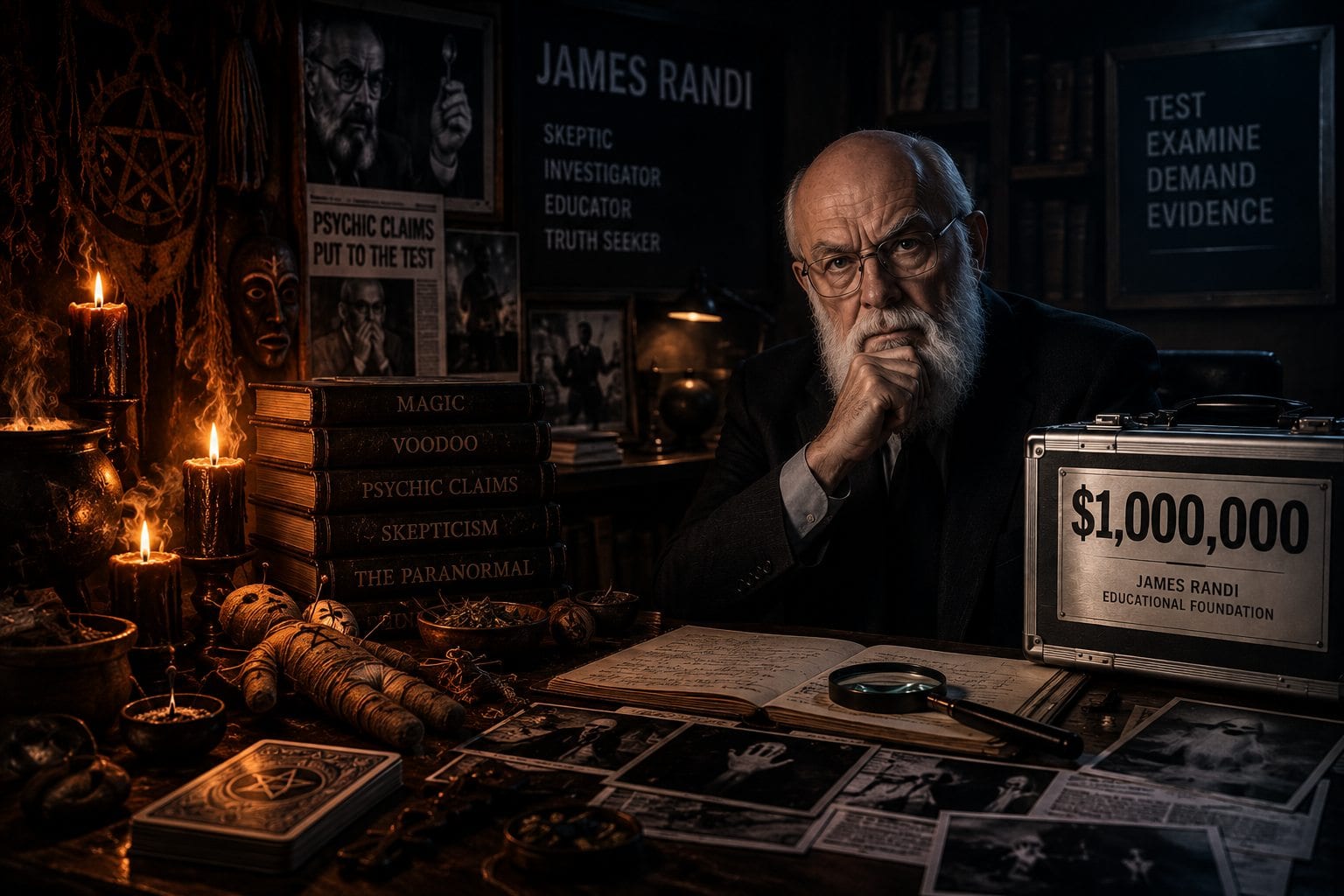
The image used with this article includes a popular visual association with Randi. The article text clarifies that the exact phrase is most famously associated with Carl Sagan.
WHEN MAGIC IS REAL AS AN ART
There is one form of magic whose existence nobody needs to prove.
Stage magic.
Professional magicians manipulate attention, perception and expectation to create experiences that appear impossible.
A great illusion works precisely because the audience's brain constructs the wrong explanation.
Magicians therefore provide fascinating demonstrations of human psychology.
Randi's unusual advantage as a paranormal investigator was that he understood both sides.
He understood how convincing an impossible event could feel.
And he understood how easily human perception could be manipulated.
THE BIGGER QUESTION
The debate about magic is ultimately about more than spells or psychics.
It concerns how humans decide what is true.
Should personal experience be enough?
When should we demand controlled evidence?
How do we separate coincidence from causation?
How do we distinguish unexplained from supernatural?
Those questions matter far beyond paranormal claims.
They apply to medicine.
Politics.
Advertising.
Social media.
Conspiracy theories.
And misinformation.
UNEXPLAINED DOES NOT MEAN SUPERNATURAL
There will always be things we cannot immediately explain.
But we do not know and therefore it is supernatural are not the same statement.
Throughout history, phenomena once attributed to supernatural forces have later received natural explanations.
Disease.
Lightning.
Eclipses.
Mental illness.
Astronomical events.
That history does not prove that every mystery will eventually receive a conventional explanation.
It teaches something more fundamental: ignorance is not evidence.
THE $1 MILLION THAT NOBODY WON
James Randi's challenge became famous because it transformed a philosophical debate into something remarkably concrete.
There was money.
There were claimants.
There were proposed tests.
And there was a simple question: can you demonstrate the ability when ordinary explanations are controlled?
The million dollars remained unclaimed.
The challenge was eventually terminated in 2015 after Randi's retirement and changes in the direction of the James Randi Educational Foundation.
Randi died in 2020.
But the question behind the challenge survived him.
THE LINE BETWEEN BELIEF AND EVIDENCE
People are free to hold spiritual and religious beliefs.
Science does not have a laboratory instrument capable of measuring every philosophical or theological idea.
But when someone makes a specific claim about the physical world, science can ask for evidence.
Can the effect be measured?
Can the test be repeated?
Can independent observers reproduce it?
Can ordinary explanations be excluded?
Until those conditions are satisfied, the scientifically responsible conclusion is not necessarily impossible.
It is not demonstrated.
THE UNKNOWN REMAINS
Human beings have always been fascinated by mystery.
That probably will never disappear.
Ghost stories will continue.
People will search for signs.
Psychics will make predictions.
Rituals will survive.
And unexplained experiences will continue to happen.
Science does not remove mystery from the world.
It gives us a method for deciding when a mystery has become evidence.
James Randi spent much of his life asking people claiming extraordinary abilities to cross that line.
A million dollars waited on the other side.
Nobody managed to claim it.
FAQ
Frequently Asked Questions
Can paranormal powers be scientifically proven?
A paranormal power affecting the observable world could, in principle, be tested. Reliable paranormal abilities have not been established under controlled scientific conditions.
Did anyone win James Randi's million-dollar challenge?
No. The James Randi Educational Foundation's One Million Dollar Paranormal Challenge was never awarded before the challenge was terminated in 2015.
Does the Randi challenge prove magic is impossible?
No. It shows that no claimant successfully demonstrated a paranormal ability under the challenge's agreed controlled conditions. That is not the same as proving every supernatural idea impossible.
Is Vodou the same as black magic?
No. Haitian Vodou is a religion and cultural tradition. Reducing it to curses, dolls or black magic repeats misleading stereotypes from popular entertainment and colonial-era portrayals.
What is the Barnum effect?
The Barnum or Forer effect is the tendency to accept vague, broadly applicable personality descriptions as uniquely accurate for oneself.
What is cold reading?
Cold reading is a performance technique in which a reader uses observation, broad questions, feedback and interpretation to create the impression of special knowledge.
Who said extraordinary claims require extraordinary evidence?
The exact modern phrase is most famously associated with Carl Sagan, although similar skeptical ideas appeared earlier. PRESDA does not attribute the exact quote to James Randi.
PRESDA Dispatch
Stay Informed. Stay Aware.
A sharp briefing across AI, gaming, sport, business, world affairs, paparazzi, and lifestyle.